Top Industries Booming Under Tinubu: Cash Out in 2026
Most Nigerians are sitting on a gold mine without even knowing it. While the headlines scream about inflation and fuel subsidies, seven specific industries are quietly minting millionaires across Lagos, Abuja, Port Harcourt, and beyond.
The Tinubu administration’s economic reforms have created unexpected winners in Nigeria’s business landscape. From the removal of fuel subsidies to the floating of the naira, these policy shifts have opened profitable gaps that smart Nigerians are exploiting right now. The question is not whether opportunities exist. The question is whether you will recognize them before they become saturated.
This article breaks down seven industries experiencing explosive growth under President Bola Ahmed Tinubu’s government. You will learn exactly what makes each sector profitable, the realistic income potential for everyday Nigerians, the barriers to entry, and practical steps to start capturing value in 2026.
I have spent over a decade analyzing African markets and advising entrepreneurs across West Africa. What follows is not speculation. It is pattern recognition based on current economic data, policy analysis, and real-world case studies from Nigerians already building wealth in these exact sectors.
Let’s get into it.
1. Renewable Energy and Solar Solutions: Nigeria’s Fastest Growing Industry
The removal of fuel subsidies changed everything overnight. Petrol prices that once hovered around ₦180 per liter jumped past ₦600 in many states. Diesel became unaffordable for most businesses. Suddenly, every household and small business in Nigeria started looking for alternatives to power their lives.
Enter the renewable energy sector, particularly solar solutions.
According to the Nigerian Renewable Energy and Energy Efficiency Association, Nigeria’s solar market is projected to grow by over 35% annually through 2027. This is not theoretical growth. Walk through any middle-class neighborhood in Lagos, Ibadan, or Kaduna today and count the solar panels on rooftops. The transformation is visible.
Why this industry booms under Tinubu:
The fuel subsidy removal made traditional generators economically unviable for continuous use. A business that previously spent ₦50,000 monthly on diesel now faces bills exceeding ₦200,000. Solar installations that seemed expensive six months ago now pay for themselves within 18 months.
Government policies under Tinubu have also reduced import duties on renewable energy equipment. The Central Bank of Nigeria introduced intervention funds specifically for renewable energy projects. States like Lagos and Rivers are offering tax incentives for businesses that adopt solar solutions.
Income potential and opportunities:
- Solar installation technicians earn between ₦150,000 and ₦500,000 monthly depending on project volume
- Solar product retailers report margins between 25-40% on equipment sales
- Solar financing agents who connect buyers with payment plans earn commission rates of 5-10% per installation
- Maintenance service providers charge ₦15,000 to ₦50,000 per service visit
Skills required:
Basic electrical knowledge for installation roles. Sales and networking skills for retail. No technical background needed for financing or brokerage positions.
Entry barriers:
Low to moderate. You can start as a sales agent for established solar companies with zero capital. Installation certification courses cost between ₦80,000 and ₦200,000 and take 2-4 weeks. Retail requires inventory investment starting from ₦500,000.
Real example:
Chidi from Enugu started as a solar installation apprentice in early 2023. After six months of training, he began taking independent contracts. By December 2023, he was installing 3-4 systems monthly at ₦80,000 per installation. His monthly income averaged ₦320,000, nearly triple what he earned as a bank customer service officer.
2. Agricultural Technology and Food Processing: Feeding a Growing Nation
Nigeria imports over $2 billion worth of food annually. The naira devaluation under Tinubu made imported food prohibitively expensive for most Nigerians. A pack of imported rice that cost ₦25,000 in 2022 now sells for ₦70,000 or more.
This created a massive demand surge for locally produced and processed foods. But here is where it gets interesting. The real money is not in farming alone. It is in the value addition, the processing, packaging, and distribution of agricultural products.
The agritech sector combines technology with traditional agriculture. Apps that connect farmers to buyers. Cold storage solutions. Food processing equipment. Organic fertilizer production. Packaging and branding services for local farmers.
Why this industry booms under Tinubu:
The administration’s focus on food security has translated into billions in intervention funds through programs like the Anchor Borrowers’ Programme expansion. The Nigeria Incentive-Based Risk Sharing System for Agricultural Lending (NIRSAL) has been recapitalized.
Currency devaluation made local production competitive again. A tomato paste manufacturer who struggled against imported brands in 2022 now enjoys natural price protection.
Income potential and opportunities:
- Food processors (garri, plantain chips, dried fish) report monthly revenues between ₦200,000 and ₦2,000,000 depending on scale
- Agritech platform operators connecting farmers to urban buyers earn commission rates of 10-15% per transaction
- Packaging and branding consultants for agricultural products charge ₦50,000 to ₦300,000 per client
- Organic fertilizer producers sell 25kg bags at ₦3,500 to ₦5,000 with production costs around ₦1,800
Skills required:
Food safety knowledge for processing. Basic digital literacy for agritech platforms. Marketing skills for branding services. Agricultural science background helpful but not mandatory.
Entry barriers:
Moderate. Processing businesses require equipment investment from ₦300,000 to ₦3,000,000 depending on product. Agritech platforms can start with ₦100,000 for basic app development and marketing. Consulting services require knowledge but minimal capital.
Real example:
Amaka in Abia State started processing cassava into high-quality garri in mid-2023. She invested ₦800,000 in a small processing facility. By branding her product as “premium organic garri” and selling through Instagram and WhatsApp, she built a customer base across Southeast Nigeria. Her monthly net profit now averages ₦350,000.
3. Digital Skills Training and Online Education: Nigeria’s Knowledge Economy Explosion
The World Bank estimates that over 40% of Nigerian youth are unemployed or underemployed. University graduates struggle to find jobs. Meanwhile, global companies desperately need digital skills. Nigerian software developers, digital marketers, and data analysts work remotely for American and European companies at salaries that dwarf local opportunities.
This gap created a booming industry in digital skills training.
Thousands of Nigerians now make money teaching other Nigerians marketable skills. Coding bootcamps. Digital marketing courses. Graphics design training. Video editing workshops. Virtual assistant certification programs.
Why this industry booms under Tinubu:
The naira devaluation made dollar-earning remote jobs incredibly attractive. A Nigerian earning $500 monthly as a freelance copywriter now receives over ₦750,000 when converted. This is more than many doctors and engineers earn locally.
Government youth empowerment programs are increasingly funding digital skills training. The Federal Ministry of Communications and Digital Economy has partnerships with training platforms. State governments offer subsidized courses.
The internet penetration in Nigeria crossed 55% in 2023 according to the Nigerian Communications Commission. More people online means more potential students.
Income potential and opportunities:
- Course creators selling recorded courses earn ₦50,000 to ₦5,000,000 monthly depending on audience size and pricing
- Live training instructors charge ₦15,000 to ₦150,000 per student per course
- Corporate trainers invoice ₦200,000 to ₦1,500,000 per training contract with companies
- Learning platform owners who aggregate courses from multiple instructors earn through subscriptions and commissions
Skills required:
Expertise in a marketable digital skill. Teaching ability. Basic marketing knowledge. Video recording and editing for online courses.
Entry barriers:
Low to moderate. Teaching skills you already possess requires minimal investment. Course recording needs basic equipment (smartphone, ring light, microphone) costing ₦80,000 to ₦200,000. Marketing and student acquisition is the real challenge.
Real example:
Tunde, a graphic designer in Lagos, started offering weekend Canva training for small business owners in 2023. He charged ₦25,000 per student and trained groups of 15-20 people monthly. After six months, he launched recorded courses on his website. Between live training and course sales, he now earns ₦600,000 to ₦900,000 monthly.
4. Logistics and Last-Mile Delivery: Moving Nigeria’s E-Commerce Boom
Nigerian e-commerce grew by over 60% between 2022 and 2024. Platforms like Jumia, Konga, and thousands of Instagram businesses ship products daily. But here is the bottleneck: reliable, affordable delivery services.
Traditional courier companies are expensive and slow. They charge ₦3,000 to ₦5,000 for intracity deliveries that take 3-5 days. E-commerce sellers and buyers want faster, cheaper options.
Smart entrepreneurs built logistics businesses filling this gap. Bike delivery services. Neighborhood pickup points. Specialized cold chain logistics for food. Interstate courier networks.
Why this industry booms under Tinubu:
Fuel price increases hurt traditional logistics companies but created opportunities for efficient, technology-driven alternatives. A logistics startup using optimized routes and bike couriers can deliver profitably at prices traditional players cannot match.
The growth of online businesses accelerated as Nigerians sought alternative income during economic pressure. More online sellers mean more delivery demand.
Payment system improvements under the current administration made cash-on-delivery more manageable. Providers can now collect payments digitally and remit to sellers seamlessly.
Income potential and opportunities:
- Independent bike couriers earn ₦3,000 to ₦8,000 daily depending on volume
- Logistics company owners with 5-10 bikes report monthly profits between ₦300,000 and ₦1,200,000
- Pickup point operators earn ₦200 to ₦500 per package handled, translating to ₦100,000 to ₦400,000 monthly
- Interstate courier consolidators who batch deliveries earn margins of 20-35%
Skills required:
Route planning and optimization. Customer service. Basic record keeping. Motorcycle riding for courier roles.
Entry barriers:
Moderate. Starting as an independent courier requires a motorcycle (₦400,000 to ₦800,000 new, ₦200,000 to ₦400,000 used). Pickup point operations need minimal investment. Company formation requires fleet investment starting from ₦2,000,000.
Real example:
Emeka in Port Harcourt noticed e-commerce sellers complaining about delivery costs in Facebook groups. He bought a used motorcycle for ₦250,000 and started offering same-day delivery at ₦1,000 for intracity shipments. Within three months, he had consistent clients sending 10-15 packages daily. He hired two additional riders by month six. His logistics business now generates ₦450,000 monthly profit.
5. Financial Technology and Digital Payment Solutions: Nigeria’s Cashless Revolution
Nigeria processes billions of naira in digital transactions daily. The Central Bank of Nigeria’s cashless policy, strengthened under Tinubu, pushed even reluctant Nigerians toward digital payments.
But financial technology goes beyond mobile banking apps. It includes point-of-sale (POS) operations, agent banking, cryptocurrency trading facilitation, savings platforms, and micro-lending services.
The POS business alone employs hundreds of thousands of Nigerians. Those small shops where you withdraw cash or make transfers. That is a multibillion-naira industry.
Why this industry booms under Tinubu:
Cash scarcity policies forced Nigerians to adopt digital payments. Even market traders now accept transfers. The administration’s support for financial inclusion expanded agent banking networks into rural areas.
The naira redesign controversy of early 2023, while disruptive, permanently shifted payment behavior. Nigerians who never used digital payments now do so daily.
Cryptocurrency adoption surged as Nigerians sought alternatives to the weakening naira. According to industry reports, Nigeria consistently ranks among the top five countries globally for crypto transaction volume. This created demand for peer-to-peer trading platforms and crypto education services.
Income potential and opportunities:
- POS operators earn ₦100 to ₦200 per transaction, translating to ₦80,000 to ₦300,000 monthly depending on location and volume
- Agent banking operators for commercial banks earn commissions on account openings, deposits, and withdrawals, averaging ₦150,000 to ₦500,000 monthly
- Crypto trading facilitators earn spreads of 2-5% per transaction
- Savings platform operators earn through management fees and investment returns
Skills required:
Basic financial literacy. Customer service. Record keeping. Security awareness to prevent fraud.
Entry barriers:
Low to moderate. POS business requires terminal deposit (₦20,000 to ₦100,000) and working capital (₦100,000 to ₦500,000). Agent banking needs physical space and larger capital base (₦500,000 to ₦2,000,000). Crypto trading can start with minimal capital but requires knowledge.
Real example:
Blessing opened a POS shop in a busy Ibadan market in early 2023. She deposited ₦50,000 for the terminal and started with ₦200,000 working capital. Her shop handles 80-120 transactions daily at an average commission of ₦150. She now earns ₦280,000 to ₦400,000 monthly and has opened a second location.
6. Content Creation and Digital Marketing Services: Nigeria’s Creative Economy
Nigerian content creators are building followings that rival international celebrities. Comedy skits, lifestyle content, educational videos, and podcasts attract millions of views. Brands pay heavily to access these audiences.
But the real opportunity extends beyond becoming an influencer yourself. Businesses across Nigeria need digital marketing services. Social media management. Content writing. Video editing. Paid advertising management. Email marketing.
Most Nigerian small businesses know they need an online presence but lack the skills to build one. This knowledge gap is a business opportunity.
Why this industry booms under Tinubu:
Economic pressure pushed businesses online. A retailer who previously relied on walk-in customers now needs Instagram and WhatsApp marketing to survive.
Internet affordability improved even as the naira weakened. Data costs decreased relative to purchasing power for digital services.
The youth unemployment crisis created supply. Thousands of educated young Nigerians with writing, design, or video skills now offer services freelance.
International platforms like Fiverr, Upwork, and Toptal enabled Nigerian creatives to earn dollars. A content writer charging ₦5,000 per article locally can earn $30 (₦45,000) per article on international platforms.
Income potential and opportunities:
- Social media managers charge ₦30,000 to ₦200,000 monthly per client
- Content writers earn ₦3,000 to ₦25,000 per article depending on length and client
- Video editors charge ₦15,000 to ₦100,000 per project
- Paid ads specialists typically charge 15-20% of ad spend as management fees
- Full-service agencies with teams report monthly revenues between ₦500,000 and ₦5,000,000
Skills required:
Writing, graphic design, video editing, or advertising knowledge. Social media savvy. Client communication and project management.
Entry barriers:
Low. Most services require only a laptop, internet connection, and skills. Software subscriptions cost ₦5,000 to ₦30,000 monthly. The main barriers are skill development and client acquisition.
Real example:
Ngozi, a mass communication graduate in Abuja, struggled to find employment after NYSC. She started offering social media management services to small businesses at ₦40,000 monthly per client. Starting with two clients from her church, she grew to eight clients within a year through referrals. She now earns ₦320,000 monthly and hired an assistant.
7. Real Estate Services and Property Technology: Nigeria’s Housing Crisis Creates Opportunities
Nigeria has a housing deficit estimated at over 17 million units. The population grows faster than housing construction. Middle-class Nigerians increasingly seek affordable housing options. Diaspora Nigerians want to invest in property back home.
This massive gap created opportunities across the real estate value chain. But you do not need millions to participate.
Real estate agency services, property management, interior decoration, furniture rental for short-term rentals, PropTech platforms connecting buyers and sellers, and real estate consultancy all offer entry points.
Why this industry booms under Tinubu:
Naira devaluation made real estate attractive as an inflation hedge. Nigerians moved savings from cash into property.
Diaspora remittances increased as the naira weakened. A Nigerian abroad finds their dollars go further in property investment. This increased foreign-sourced demand.
The mortgage system shows signs of improvement under current housing policies. The Federal Mortgage Bank recapitalization made home loans more accessible to middle-income Nigerians.
Short-term rental platforms like Airbnb grew as international travel to Nigeria increased. Property owners earn dollar-denominated income from short-term rentals.
Income potential and opportunities:
- Real estate agents earn 5-10% commission on property sales, translating to ₦250,000 to ₦5,000,000 per transaction depending on property value
- Property managers charge 10-15% of monthly rent for landlord representation, averaging ₦100,000 to ₦800,000 monthly with a portfolio of properties
- Interior decorators invoice ₦150,000 to ₦2,000,000 per project
- Short-term rental managers earn 20-30% of rental income
- Property sourcing consultants for diaspora clients charge ₦200,000 to ₦1,500,000 per successful property acquisition
Skills required:
Market knowledge. Networking abilities. Negotiation skills. For technical roles like interior decoration, design knowledge is essential.
Entry barriers:
Low to moderate. Agency work requires no capital, only networking and market knowledge. Property management needs organizational skills and client acquisition. Interior decoration requires design skills and supplier relationships.
Real example:
Kunle in Lagos started helping friends find apartments while working his 9-to-5 job. After successfully placing five people in rentals and earning agent commissions totaling ₦850,000, he realized the potential. He built a database of properties and a network of landlords and property developers. Within 18 months of focusing full-time, he now earns ₦400,000 to ₦1,200,000 monthly from property transactions and management fees.
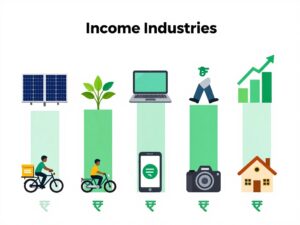
Side-by-Side Comparison: Which Industry Fits Your Life?
| Industry | Monthly Income Potential | Weekly Time Investment | Skill Barrier | Startup Capital | Work Location Flexibility | Best For |
|---|---|---|---|---|---|---|
| Renewable Energy/Solar | ₦150,000 – ₦500,000 | 30-50 hours | Moderate (technical training needed) | ₦80,000 – ₦500,000 | Moderate (installation requires field work) | People with technical aptitude, enjoy hands-on work |
| Agritech/Food Processing | ₦200,000 – ₦2,000,000 | 40-60 hours | Low to Moderate | ₦300,000 – ₦3,000,000 | Low (production requires physical location) | People interested in manufacturing, production, or agriculture |
| Digital Skills Training | ₦200,000 – ₦900,000 | 15-35 hours | Moderate (must know marketable skill) | ₦80,000 – ₦200,000 | High (fully remote possible) | Experts in any digital skill willing to teach |
| Logistics/Delivery | ₦100,000 – ₦1,200,000 | 40-70 hours | Low | ₦200,000 – ₦2,000,000 | Low (active movement required) | Energetic individuals, good with planning and people |
| Fintech/Digital Payments | ₦80,000 – ₦500,000 | 35-60 hours | Low | ₦120,000 – ₦2,000,000 | Moderate (requires physical location for POS/agent banking) | People in high-traffic areas, trustworthy, good with numbers |
| Content/Digital Marketing | ₦120,000 – ₦5,000,000 | 20-50 hours | Moderate (creative/technical skills needed) | ₦50,000 – ₦150,000 | High (fully remote possible) | Creative individuals, writers, designers, video editors |
| Real Estate Services | ₦100,000 – ₦5,000,000+ | 20-45 hours | Low to Moderate | ₦0 – ₦500,000 | High (flexible with networking) | People with strong networks, negotiation skills, market knowledge |
How to read this table:
Income potential represents realistic ranges for individuals with 6-18 months experience. Beginners typically start at the lower end.
Time investment includes learning, client acquisition, and service delivery.
Startup capital reflects the minimum to begin professionally, not including living expenses.
The Hidden Challenges Nobody Talks About
Every glowing business opportunity article paints success as inevitable. Let me tell you what actually happens when Nigerians enter these industries.
Challenge 1: Payment collection difficulties
Nigerian clients often delay payments. A social media manager might deliver three months of excellent work before receiving full payment. A logistics operator extends credit to e-commerce clients who disappear after delivery. This cash flow challenge kills more businesses than competition.
Solution: Require upfront deposits (30-50% minimum). Use escrow services for large transactions. Build payment terms into your pricing. Never extend credit beyond what you can afford to lose.
Challenge 2: Infrastructure instability
Power outages destroy productivity. Internet disruptions halt digital businesses. Bad roads damage delivery vehicles. These are not occasional problems. They are daily realities affecting profit margins.
Solution: Build infrastructure costs into your pricing. A digital marketer needs backup power solutions. A logistics company needs vehicle maintenance budgets 50% higher than standard. Budget realistically for the Nigerian operating environment.
Challenge 3: Market education burden
Many potential clients do not understand your service value. A small business owner thinks ₦50,000 monthly for social media management is expensive because they do not understand what social media management entails.
Solution: Invest time in education-based marketing. Create content that teaches potential clients why your service matters. Offer free value before selling. The businesses that educate their markets win.
Challenge 4: Scams and fraud
The digital payment sector faces cyber fraud. E-commerce delivery involves package theft. Real estate deals attract scammers. Content creators face intellectual property theft.
Solution: Verify every client before service delivery. Use secure payment platforms. Document everything. Learn basic cybersecurity. Join industry groups that share fraud alerts.
Challenge 5: Inconsistent income
Unlike salaried employment, these industries produce variable monthly income. You might earn ₦600,000 in March and ₦150,000 in April. This volatility stresses people unprepared for it.
Solution: Build an emergency fund covering 3-6 months of expenses before leaving stable employment. Diversify income sources within your industry. Create retainer-based services for predictable baseline income.
Starting Smart: Your First 90 Days
You have read about seven booming industries. You feel excited about the possibilities. Now what?
Days 1-30: Research and skill audit
Choose one industry based on your current skills, available capital, and lifestyle compatibility. Do not chase the highest income potential if it requires skills you lack or capital you do not have.
Research that industry thoroughly. Join Nigerian Facebook groups, WhatsApp communities, and Twitter spaces focused on that sector. Listen more than you speak. Ask questions. Learn from those already operating.
Audit your existing skills honestly. A banker has financial literacy applicable to fintech. A teacher has presentation skills valuable for digital training. A driver knows routes useful for logistics. Identify your transferable skills.
Days 31-60: Skill development and network building
Invest in targeted skill development. Take that solar installation course. Learn professional video editing. Study digital marketing through free and paid resources.
Start building your network before you need it. Connect with potential suppliers, partners, and clients. Attend industry meetups. Contribute value in online communities. Networking before needing favors builds genuine relationships.
Days 61-90: Soft launch and iteration
Start small with your first clients or customers. Charge below market rates initially to build portfolio and testimonials. Deliver exceptional value.
Gather feedback aggressively. What did clients love? What confused them? What would they pay more for? Use this intelligence to refine your offering.
Document your systems. How do you onboard clients? What is your delivery process? How do you handle payments? Early systematization allows scaling later.
The Tinubu Effect: Policy Tailwinds to Watch in 2026
Understanding policy direction helps you position strategically. Several government initiatives under Tinubu will likely accelerate growth in these industries through 2026.
The Student Loan Scheme: When fully operational, this increases disposable income among young Nigerians, expanding markets for digital services, e-commerce (boosting logistics), and skills training.
Infrastructure Development Focus: Planned improvements to national grid and road networks reduce operating costs for logistics and solar businesses while improving overall business environment.
Digital Economy Push: Government partnerships with tech companies and digital infrastructure investments favor fintech, digital marketing, and e-learning platforms.
Food Security Initiatives: Continued agricultural support programs with billions in intervention funds favor agritech and food processing businesses.
Housing Program Expansion: Commitment to address housing deficit creates opportunities across real estate value chain.
Stay informed about policy changes. Government contracts, grants, and intervention programs often target these exact sectors. Position yourself to benefit.
Conclusion: Your Move in Nigeria’s Economic Chess Game
The Tinubu administration’s policies created economic disruption. Currency devaluation hurts. Fuel subsidy removal stings. But disruption always creates winners and losers.
The seven industries explored in this article are winning. Solar energy because fuel became expensive. Agritech because imports became unaffordable. Digital skills training because remote dollar-earning became attractive. Logistics because e-commerce exploded. Fintech because cash became scarce. Content creation because businesses need online presence. Real estate because Nigerians hedge against inflation.
These are not get-rich-quick schemes. They require work, skill development, and persistence. But they offer realistic paths to building ₦200,000 to ₦1,000,000+ monthly income within 12-24 months for people willing to execute.
The question is not whether opportunities exist under Tinubu’s economic policies. The evidence confirms they do. The question is whether you will take informed action or watch from the sidelines as others build wealth.
Nigeria rewards those who spot patterns early and execute decisively. The pattern is clear. These seven industries are booming. The execution part is up to you.
Your Next Step
Which of these seven industries resonates most with your current skills and situation? Drop a comment below sharing your choice and biggest question about getting started.
If you found this analysis valuable, share it with one Nigerian friend who needs to see these opportunities. Our community grows stronger when we share knowledge.
Ready to dive deeper? Subscribe to our newsletter for weekly insights on building wealth in Nigeria’s evolving economy. We break down complex economic trends into actionable business intelligence you can use immediately.
Let’s build together.