
Your salary just hit your account: ₦70,000.
Before you can even exhale, mental calculations have already started: Rent is ₦25,000 (if you’re sharing a room in Surulere or Ikeja). Food for the month: ₦18,000 minimum (if you eat plain rice with stew). Transport to work: ₦8,000-₦12,000 depending on how far Lekki traffic pushes you. Electricity (that NEPA barely supplies): ₦3,000-₦5,000. Phone and internet: ₦2,500.
You’ve allocated ₦68,500. You have ₦1,500 left.
And you haven’t bought soap. Haven’t set aside money for emergencies. Haven’t contributed to your friend’s wedding. Haven’t even thought about saving.
This is not just your reality—this is the reality of millions of Nigerians in 2026.
The naira hit ₦1,850 to one dollar. Inflation consumed another 32% of purchasing power this year alone. Your salary hasn’t moved. Your cost of living has tripled. And yet, you’re supposed to survive, save, and somehow build a future on ₦70,000 salary in Lagos.
Here’s what nobody tells you: It’s possible. Not easy. But absolutely possible.
In this article, I’m sharing the exact survival plan that real low-wage Nigerians are using in 2026 to not just survive on ₦70,000 monthly, but to actually save ₦8,000-₦15,000 AND earn $100-$300 monthly in dollars through side hustles. This isn’t fantasy. This is mathematics + strategy + discipline.
By the end of this guide, you’ll have a concrete budget breakdown, realistic side hustle strategies designed for low-income earners, and a 12-month wealth-building plan that works even when your salary doesn’t.
Let’s get you from “how do I survive?” to “how do I thrive?”
The ₦70,000 Reality Check: What Your Salary Actually Buys in 2026 Lagos
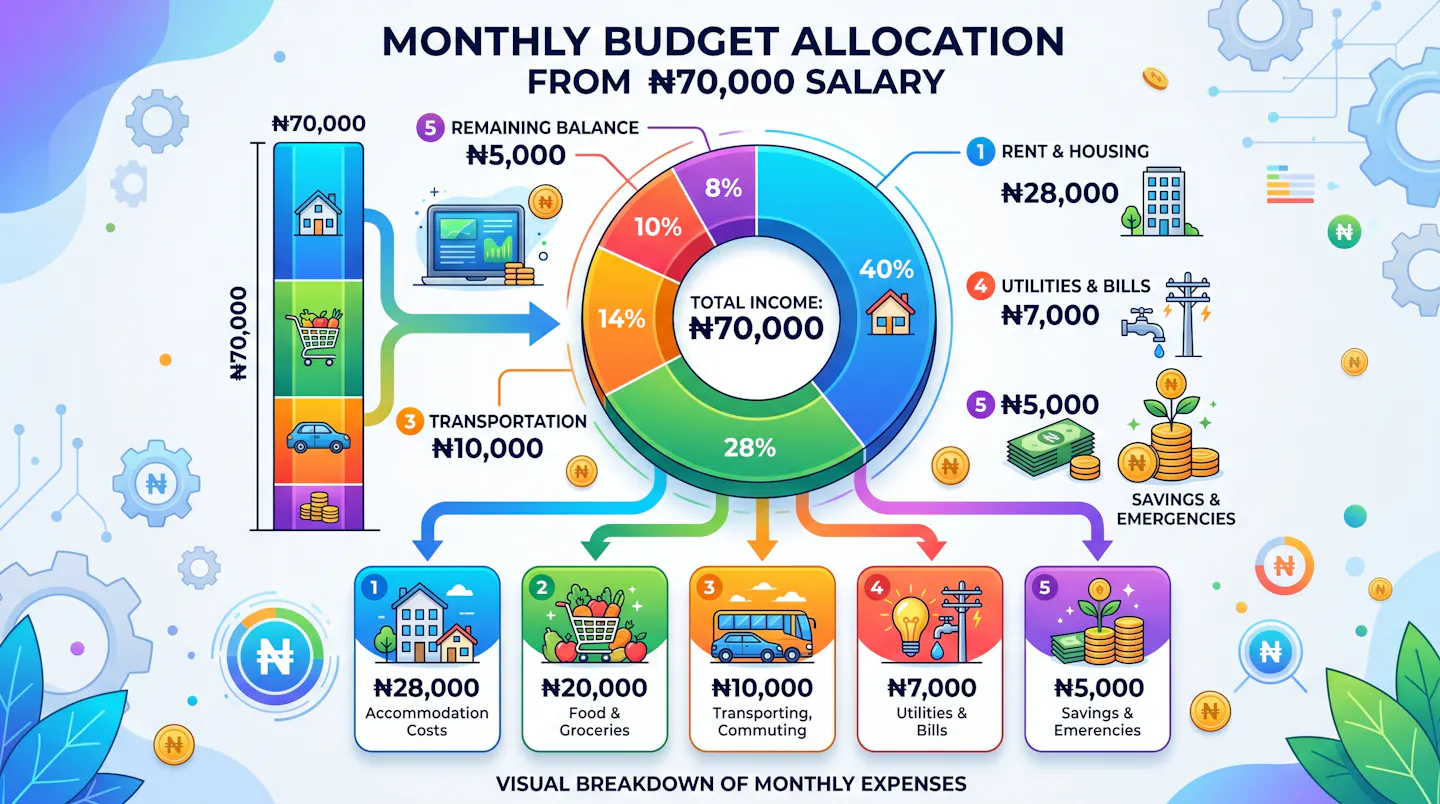
Before we talk survival, we need brutal honesty about what ₦70,000 actually represents in 2026 Nigeria.
Historical context that’ll make you angry:
- In 2015, ₦70,000 was a decent middle-class salary
- In 2020, it was tight but manageable
- In 2026, it’s below the poverty line by World Bank standards (which defines poverty as living on less than $1.90/day—about ₦3,500/day, or ₦105,000/month)
But here’s the thing: You’re not living by World Bank standards. You’re living in Lagos where bread costs ₦500, okada costs ₦500, and your landlord doesn’t care about poverty definitions—he wants ₦25,000 on the 1st.
The Real ₦70,000 Monthly Breakdown (Lagos/Abuja 2026 Prices)
MUST-HAVE EXPENSES (No choices here):
| Expense | Amount | Notes |
|---|---|---|
| Accommodation | ₦25,000 | Shared room, no toilet inside. If you have your own apartment, ₦50,000-₦80,000 (means ₦70,000 salary doesn’t exist for you) |
| Food | ₦18,000 | Rice, beans, eggs, garri, salt, oil. No meat, no luxury. ₦600/day |
| Transport | ₦10,000 | ₦500 × 20 working days. More if you use Uber (₦2,000-₦5,000/day) |
| Electricity | ₦4,000 | NEPA (when it comes) + generator fuel during blackouts |
| Phone/Internet | ₦3,000 | MTN data ₦1,000, airtime ₦500, internet ₦1,500 |
| Water | ₦1,500 | If not included in rent |
| Toiletries/Cleaning | ₦2,000 | Soap, toothpaste, deodorant, detergent |
| Medical contingency | ₦3,000 | You WILL get sick at least once |
| Miscellaneous | ₦1,500 | Unexpected expenses (phone repair, shoelace, etc.) |
| TOTAL | ₦68,000 | Leaves ₦2,000 cushion |
What this table reveals:
✗ ZERO savings on just salary
✗ ZERO money for clothes (what are you wearing next month?)
✗ ZERO money for emergencies (what if you lose your job?)
✗ ZERO ability to invest in skills, education, or side hustles
✗ ZERO margin for error (one unexpected expense = crisis)
The brutal truth: ₦70,000 salary alone is mathematically insufficient to survive in Lagos with dignity AND security AND growth.
Therefore, the question is NOT “Can I survive on ₦70,000?” (You probably can, barely.)
The real question is: “How do I supplement ₦70,000 so I can actually save AND earn in dollars?”
This is where the survival plan begins.
The Three-Pillar Survival Strategy for Low-Salary Earners in Nigeria
Your ₦70,000 salary is fixed. You can’t increase it (at least not this month). But you can control everything else.
The 3-pillar survival plan works like this:
Pillar 1: Slash Your Expenses by 20-30% (Find ₦8,000-₦15,000)
Pillar 2: Optimize Your Current Job (Earn ₦5,000-₦20,000 bonus)
Pillar 3: Launch Side Hustles (Earn ₦30,000-₦150,000 monthly + dollars)
Together, these pillars transform your financial reality from “barely surviving” to “actually building something.”
Pillar 1: The Ruthless Expense-Cutting Plan — Finding Hidden ₦8,000-₦15,000 Monthly
Most low-income Nigerians think their money just “disappears.” They don’t realize where exactly it’s leaking. This pillar is about finding those leaks and plugging them.
The ₦70,000 Salary Expense Audit (Do This TODAY)
Step 1: Track EVERY transaction for 7 days
Use your phone notes or a small notebook. Write down:
- Every transport fare
- Every food purchase
- Every subscription
- Every small expense
Example log:
- Morning: ₦300 for water
- Transport: ₦500
- Breakfast: ₦500
- Lunch: ₦1,200
- Airtime: ₦500
- Evening okada: ₦500
- Supper: ₦800
- Daily total: ₦4,800
Weekly total: ₦33,600
Monthly projection: ₦142,400 (!!)
This reveals the first shocker: You’re spending almost ₦72,000 without realizing it.
The Seven Expense Categories Where Low-Income Nigerians Leak Money
LEAK #1: Transport (Saving: ₦2,000-₦4,000/month)
Current spending: ₦500 × 20 work days = ₦10,000/month (if honest)
Reality: Most people spend ₦12,000-₦15,000 because:
- Extra trips (personal errands, social visits)
- Occasional Uber instead of okada (₦3,000 vs ₦500)
- Weekend movement not budgeted
How to cut ₦2,000-₦4,000:
Option 1: Bike/Motorcycle (if you can afford one)
- Cost: ₦80,000-₦150,000 (used)
- Daily fuel: ₦500-₦1,000
- Saves: ₦8,000-₦12,000/month vs Uber
- Payback period: 8-12 months
Option 2: Change Location/Job
- If job is far (requires ₦500+ daily transport)
- Look for closer position (even if pay is same)
- Walking distance work = ₦0 transport
- Saves: ₦10,000/month
Option 3: Negotiate Work-from-Home Days
- Ask for 2-3 WFH days/week
- Reduces transport to ₦4,000-₦6,000/month
- Saves: ₦4,000-₦6,000/month
Option 4: Carpool/Bus Buddy
- Share okada with colleague (₦250 each instead of ₦500)
- Saves: ₦2,500/month
Realistic monthly transport budget after cuts: ₦6,000-₦8,000
Savings: ₦2,000-₦4,000
LEAK #2: Food (Saving: ₦3,000-₦6,000/month)
Current spending: ₦18,000/month on bare-minimum food
Hidden spending: Extra meals, restaurant food, snacks
- Occasional “small chop” (₦500)
- Fufu and egusi soup (₦2,000)
- Biscuits/sweets (₦1,500)
- Real monthly food spend: ₦24,000-₦28,000
How to cut ₦3,000-₦6,000:
Strategy 1: Meal Prep on Sundays
- Cook large batch: 3kg rice, 2kg beans, vegetables
- Cost: ₦5,000
- Lasts 5-7 days
- Prevents emergency food buying
- Saves: ₦3,000-₦4,000/month
Strategy 2: Eliminate Restaurant Food Completely
- Average: ₦1,500/day × 20 days = ₦30,000/month (if you eat out daily)
- By cooking: ₦600/day × 20 days = ₦12,000/month
- Saves: ₦18,000/month (but extreme)
- Realistic: Cut from 5 restaurant days to 2 = save ₦4,500/month
Strategy 3: Change Protein Source
- Current: Chicken (₦800/portion) × 25 portions = ₦20,000/month
- Alternative: Eggs (₦300 each) × 30 eggs = ₦9,000/month
- Or: Fish (₦400/small tin) = ₦4,000/month
- Saves: ₦10,000-₦16,000/month
Strategy 4: Buy in Bulk at Mile 12 Market
- Rice: ₦12,000/bag (25kg) = ₦480/kg vs ₦600/kg retail
- Beans: ₦3,000/bag (10kg) = ₦300/kg vs ₦400/kg retail
- Saves: ₦2,000-₦3,000/month
Strategy 5: Reduce Carbs, Increase Vegetables
- Garri with okra (₦500) beats rice with stew (₦1,500)
- Boiled plantain (₦400) beats fried rice (₦2,000)
- Saves: ₦2,000-₦3,000/month
Realistic monthly food budget after cuts: ₦12,000-₦15,000
Savings: ₦3,000-₦6,000
LEAK #3: Subscriptions & Services (Saving: ₦1,500-₦3,000/month)
Subscriptions most ₦70,000 salary earners have:
- Netflix: ₦5,200/month (WHO TOLD YOU TO SUBSCRIBE?!)
- Spotify: ₦1,900/month
- MTN Pulse 100: ₦100/month
- Gaming subscriptions: ₦2,000/month
- YouTube Premium: ₦1,900/month
- Total: ₦11,100/month on entertainment
Reality check: You’re spending 15% of your salary on entertainment you don’t need.
How to cut ₦1,500-₦3,000:
Strategy 1: Kill Entertainment Subscriptions
- Netflix → Use free YouTube (thousands of shows)
- Spotify → Use YouTube Music (free version)
- Save: ₦7,100/month
Strategy 2: Keep ONLY Essential Subscriptions
- Phone data for work: ₦1,500 ✓
- WhatsApp for communication: ₦0 (included in data) ✓
- Banking app: ₦0 ✓
- Everything else: KILL IT ✗
- Save: ₦10,000/month
Strategy 3: Negotiate with Service Providers
- Call your phone company’s retention team
- Say “I’m switching to a competitor”
- They’ll offer you 50% discount on data
- Save: ₦500-₦1,000/month
Realistic subscription budget after cuts: ₦1,500 (data only)
Savings: ₦1,500-₦3,000
LEAK #4: Impulse Purchases (Saving: ₦1,500-₦4,000/month)
What are impulse purchases?
- That shirt that caught your eye (₦3,000)
- Phone accessories (₦2,000)
- Cheap shoes (₦2,500)
- Drinks when hanging out (₦1,000)
- Contributing to group things you don’t need (₦2,000)
- Monthly impulse spending: ₦5,000-₦15,000
How to cut ₦1,500-₦4,000:
Strategy 1: The 7-Day Rule
- See something you want?
- Wait 7 days
- 90% of the time, you won’t want it
- Saves: ₦3,000-₦6,000/month
Strategy 2: Use Cash Instead of Card
- Withdraw only your budgeted amount
- When it’s gone, it’s gone
- Can’t overspend
- Saves: ₦2,000-₦5,000/month
Strategy 3: Unsubscribe from Shopping Alerts
- Jumia, Konga, Fashion retailers
- Stop sending you “Limited Time Offers”
- Out of sight = out of mind
- Saves: ₦1,000-₦3,000/month
Strategy 4: Dress Budget: ₦1,000/month Maximum
- ₦12,000/year on clothes
- Buy 1 quality shirt/trousers every 3 months
- Saves: ₦3,000/month vs current spending
Realistic impulse purchase budget after cuts: ₦1,000/month (emergency only)
Savings: ₦3,000-₦6,000
LEAK #5: Social Obligations (Saving: ₦1,000-₦3,000/month)
Hidden costs of being Nigerian:
- Friend’s wedding contribution: ₦5,000-₦10,000
- Another friend’s naming ceremony: ₦5,000
- Colleague’s birthday: ₦2,000
- Mosque/Church collection: ₦1,000
- “Help my brother with school fees”: ₦5,000
- Monthly social expenses: ₦10,000-₦20,000
How to cut ₦1,000-₦3,000 (without being rude):
Strategy 1: Set Fixed Social Budget
- Allocate: ₦3,000/month for ALL social obligations
- When it runs out, you attend but don’t contribute
- No shame—people understand
Strategy 2: Consolidate Gifts
- Instead of ₦2,000 for each birthday (5 colleagues)
- Group with others: ₦500 from you + ₦500 × 3 others = ₦2,000 group gift
- Saves: ₦8,000/month
Strategy 3: Be Selective
- Attend the important events only
- Skip the ones where your absence won’t be noticed
- Saves: ₦5,000-₦10,000/month
Strategy 4: Communicate Boundaries
- Tell friends: “I’m on a tight budget right now”
- Good friends understand
- Saves: ₦3,000-₦5,000/month
Realistic social obligations budget after cuts: ₦2,000/month
Savings: ₦8,000-₦15,000
LEAK #6: Utilities and “Extras” (Saving: ₦1,000-₦2,000/month)
Hidden utility costs:
- Generator fuel: ₦5,000-₦8,000 (if NEPA is very bad)
- Extra water purchases: ₦1,500-₦2,000
- Laundry service: ₦2,000
- Total: ₦8,500-₦12,000
How to cut ₦1,000-₦2,000:
Strategy 1: Wash Clothes Yourself
- Use bucket, water, detergent (₦200/week)
- No laundry guy (₦2,000/week)
- Saves: ₦7,200/month
Strategy 2: Reduce Generator Use
- Use when absolutely necessary
- Only charge phone, TV on solar/outlet
- Saves: ₦2,000-₦4,000/month
Strategy 3: Collect Water in Rainy Season
- Store in buckets
- Reduces paid water buying
- Saves: ₦1,000-₦1,500/month
Realistic utilities budget after cuts: ₦3,000/month
Savings: ₦1,500-₦3,000
LEAK #7: Random Miscellaneous (Saving: ₦500-₦1,500/month)
Where does the rest disappear?
- Borrowed money to friends (never returned)
- Small snacks throughout the day
- Okada rides for “quick errands”
- Cosmetics/haircare products
- Replacing lost/damaged items
- Untracked monthly: ₦5,000-₦10,000
How to cut ₦500-₦1,500:
Strategy 1: Use WhatsApp Instead of Visiting
- Want to see a friend? Call them
- Don’t spend ₦2,000 okada fare
- Saves: ₦1,000-₦2,000/month
Strategy 2: Meal Timing
- Eat breakfast before leaving home (₦300 at home vs ₦500 outside)
- Pack lunch (₦300 at home vs ₦1,500 outside)
- Saves: ₦800-₦1,200/month
Strategy 3: Say “No” to Borrowing Friends Money
- Every ₦1,000 you lend = ₦1,000 you won’t see again
- Saves: ₦2,000-₦5,000/month
Strategy 4: Stop Replacing Broken Gadgets Immediately
- Use broken phone for 2-3 months longer
- Save up, buy good replacement
- Saves: ₦1,000-₦2,000/month in accumulated repairs
Realistic miscellaneous budget after cuts: ₦1,000/month
Savings: ₦3,000-₦5,000
The ₦70,000 Salary REVISED Budget (After Pillar 1 Cuts)
| Category | Original | Cut | Revised |
|---|---|---|---|
| Rent | ₦25,000 | ₦0 | ₦25,000 |
| Food | ₦18,000 | -₦4,000 | ₦14,000 |
| Transport | ₦10,000 | -₦3,000 | ₦7,000 |
| Electricity | ₦4,000 | -₦1,000 | ₦3,000 |
| Phone/Internet | ₦3,000 | -₦1,500 | ₦1,500 |
| Water | ₦1,500 | -₦500 | ₦1,000 |
| Toiletries | ₦2,000 | -₦500 | ₦1,500 |
| Medical | ₦3,000 | ₦0 | ₦3,000 |
| Social/Misc | ₦6,500 | -₦7,000 | ₦0 (moved to Step 3) |
| TOTAL | ₦73,000 | -₦17,500 | ₦56,000 |
What this means:
- Original budget: ₦73,000 (OVERSPENDING by ₦3,000)
- Revised budget: ₦56,000 (SAVING ₦14,000!)
- Money freed up: ₦14,000-₦17,000 monthly
This is massive. You just found ₦14,000-₦17,000 by being intentional. Not by earning more. Just by cutting smart.
Pillar 2: Optimize Your Current Job — Earning ₦5,000-₦20,000 Extra Monthly (Without a Raise)
(Suggested Image: A Nigerian worker at desk being recognized, receiving bonus/incentive, with upward income arrow)
Reality: Your ₦70,000 salary probably won’t increase this year. NEPA won’t give raises. Economic situation won’t improve overnight.
But here’s what you CAN do: Earn extra money from your current job—not a second job, just optimization of your current role.
Strategy 1: Performance Bonuses (Earn ₦5,000-₦15,000)
How most low-wage earners leave money on the table: They don’t know their company has performance incentive programs.
Types of performance bonuses:
- Sales targets (if you’re in sales)
- Productivity metrics (if tracked)
- Attendance bonuses (perfect attendance)
- Quality bonuses (low error rates)
- Customer satisfaction scores
Action: Ask your manager/HR:
- “Are there any performance incentive programs?”
- “What metrics determine bonuses?”
- “How much can I earn with good performance?”
Real example: Chidi earns ₦70,000 base salary at a telecommunications company. He discovered there’s a ₦5,000 bonus for zero absences monthly. By being consistent, he earns ₦60,000 bonus/year. That’s ₦5,000/month extra—7% raise, basically free.
Realistic earning: ₦2,000-₦8,000/month if your company has this
Strategy 2: Overtime Work (Earn ₦3,000-₦12,000)
If your job is hourly or has overtime provisions:
- Extra hours = extra pay
- Most companies pay overtime at 1.5x-2x hourly rate
- ₦70,000/month ÷ 160 hours = ₦437/hour
- 10 hours overtime/month × ₦656 (1.5x) = ₦6,560
How to position yourself for overtime:
- Be reliable (show up on time)
- Volunteer for extra shifts
- Take on projects during busy seasons
- Work on projects with overtime budgets
Realistic earning: ₦3,000-₦15,000/month depending on job
Strategy 3: Internal Side Projects (Earn ₦2,000-₦10,000)
Many companies allow employees to take on internal projects for extra pay.
Examples:
- Social media management for company (₦5,000/month)
- Writing company newsletters (₦3,000/month)
- Training new staff (₦2,000/month)
- Coordinating events (₦5,000/month)
How to find these:
- Ask your manager: “Are there any internal projects with separate compensation?”
- Check company bulletin boards
- Talk to HR about development opportunities
Realistic earning: ₦2,000-₦10,000/month
Strategy 4: Referral Bonuses (Earn ₦3,000-₦20,000)
Many companies pay referral bonuses when you bring new hires.
How it works:
- Company gets your referral ✓
- Person gets hired ✓
- You receive bonus (usually 10-30% of first month’s salary)
- Your referral bonus: ₦7,000-₦21,000
Realistic earning: ₦3,000-₦20,000/year (non-monthly, but possible)
Strategy 5: Teach Colleagues (Earn ₦1,000-₦5,000)
If you have skills others need:
- Teach Excel (₦1,000 per person for 2-hour session)
- Teach English (₦2,000 per person)
- Teach social media (₦1,500 per person)
- Train on software (₦2,000 per person)
Earn during lunch breaks, after work hours.
Realistic earning: ₦1,000-₦8,000/month
Pillar 2 Summary:
Realistic monthly extra earnings from current job: ₦5,000-₦20,000
Pillar 3: Launch Side Hustles for Low-Income Earners — Earn ₦30,000-₦150,000 + Dollars Monthly
(Suggested Image: A collage showing different side hustles—freelancer on laptop, delivery rider, phone reseller, online seller—all earning simultaneously)
This is the game-changer. Pillars 1 and 2 give you breathing room. Pillar 3 is where you actually build wealth.
The problem: Most “side hustle” advice assumes you have capital (₦50,000+) or technical skills (coding, design). You might have neither.
This section focuses on side hustles specifically designed for ₦70,000 salary earners with minimal capital.
The Three-Speed Side Hustle Framework
Speed 1: INSTANT (Start this week, earn within days)
Speed 2: SHORT-TERM (Start this month, earn consistently by week 4-6)
Speed 3: LONG-TERM (Start this month, earn significantly by month 3+)
SPEED 1: Instant Side Hustles (₦2,000-₦15,000 in First Week)
These require zero capital, minimal skills, pure work ethic.
INSTANT #1: Help/Errand Services (₦2,000-₦10,000 weekly)
What you do:
- Run errands for busy people
- Deliver packages
- Fetch documents
- Stand in queues for people
- Walk to NEPA office, bank, etc.
How to start:
- Join TaskRunner (www.taskrunner.ng) or Help (Facebook groups: “[Your City] Help Services”)
- Advertise on WhatsApp: “I run errands for ₦500-₦2,000 per task”
- Find 5-10 regular clients who use you weekly
Earning potential:
- 3-5 tasks/day × ₦1,000 average = ₦3,000-₦5,000 daily
- Work 5 days/week = ₦15,000-₦25,000/week
- Monthly: ₦30,000-₦60,000
Reality: Most earn ₦5,000-₦15,000 weekly starting out
Capital required: ₦0
Time to first earning: 2-3 days
INSTANT #2: Sell Mobile Airtime/Data (₦2,000-₦8,000 weekly)
What you do:
- Buy airtime at 5% discount
- Resell to friends, neighbors, colleagues
- Earn the 5% margin + convince customers to pay slightly more
How to start:
- Register on Husmodata.com or Topupearn.com (free)
- Fund with ₦1,000-₦5,000
- Tell people: “I sell airtime/data. Better rates than the shop.”
Earning potential:
- Sell ₦50,000/week at 3-5% margin = ₦1,500-₦2,500 profit/week
- Monthly: ₦6,000-₦10,000
Capital required: ₦1,000-₦5,000 (you get back when you reinvest)
Time to first earning: Same day
INSTANT #3: Weekend Trading (₦3,000-₦20,000 weekly)
What you do:
- Buy items at lower price (market)
- Sell at higher price (Facebook, WhatsApp, street)
- Repeat with highest-demand items
Items that move fast:
- Phone accessories (₦500 cost → ₦1,500 sell = ₦1,000 profit each)
- Recharge cards (₦100 margin per ₦10,000 sold)
- Snacks/drinks (₦300 cost → ₦500 sell)
- Cosmetics (₦2,000 cost → ₦5,000 sell)
How to start:
- Identify what sells in your area
- Buy 5-10 units
- Sell on Facebook Marketplace + WhatsApp Status
- Reinvest profit into more stock
Earning potential:
- Sell ₦50,000 stock with 20% margin = ₦10,000 profit/weekend
- Monthly: ₦20,000-₦40,000
Capital required: ₦5,000-₦20,000
Time to first earning: 3-7 days
INSTANT #4: Day Labor / Gig Work (₦3,000-₦15,000 weekly)
What you do:
- Manual labor (construction, cleaning, moving)
- Event setup/breakdown
- Delivery assistance
- Farm work (if in rural area)
Platforms:
- TaskRunner
- Facebook groups: “[Your City] Urgent Jobs”
- Jumia Services
Earning potential:
- ₦3,000-₦8,000/day for physical work
- Work 3-4 days/week = ₦9,000-₦32,000/week
- Monthly: ₦36,000-₦128,000
Capital required: ₦0
Time to first earning: 2-3 days
Note: This is hard work but immediate cash
INSTANT #5: Phone Recharge/SIM Sales (₦2,000-₦12,000 weekly)
What you do:
- Buy SIM cards from networks at bulk discount
- Sell to new customers
- Earn ₦200-₦500 per SIM
How to start:
- Contact MTN/Airtel/Glo distributor in your area
- Buy ₦5,000 worth of SIM cards
- Sell on street, WhatsApp, Facebook
Earning potential:
- Sell 20 SIM cards/week × ₦300 profit = ₦6,000/week
- Monthly: ₦24,000
Capital required: ₦3,000-₦10,000
Time to first earning: 3-5 days
Realistic SPEED 1 Monthly Income: ₦15,000-₦40,000
SHORT-TERM Side Hustles (₦10,000-₦60,000 Monthly)
These require slightly more setup but higher consistent earnings.
SHORT-TERM #1: Freelance Writing/Content (₦20,000-₦80,000)
What you do:
- Write articles, social media posts, product descriptions
- Work for businesses, websites, publications
- Get paid ₦2,000-₦10,000 per article
How to start:
- Create portfolio (3-5 sample articles)
- Register on Fiverr.com (sell writing services)
- Join Facebook groups: “Nigerian Writers,” “Content Writing Jobs”
- Pitch directly to businesses on Instagram
Time to first paying gig: 1-2 weeks
Earning potential:
- Write 2-4 articles/month × ₦5,000 average = ₦10,000-₦40,000/month
- Experienced writers: ₦80,000-₦200,000/month
Capital required: ₦0
SHORT-TERM #2: Tuition/Coaching (₦15,000-₦100,000)
What you do:
- Teach English, Maths, sciences, languages
- Coach students for exams (WAEC, JAMB, etc.)
- Work online or in-person
How to start:
- Register on Tuteria.com or Vedantu
- Create WhatsApp status: “I offer one-on-one coaching”
- Contact schools, ask if students need tutoring
Earning potential:
- ₦2,000-₦5,000 per 1-hour session
- 4-8 sessions/week = ₦8,000-₦40,000/week
- Monthly: ₦32,000-₦160,000
Capital required: ₦0
Best for: Teachers, recent graduates, knowledgeable people
SHORT-TERM #3: Social Media Management (₦20,000-₦100,000)
What you do:
- Manage Instagram/Facebook for small businesses
- Create posts, respond to comments, grow followers
- Charge ₦15,000-₦50,000/month per client
How to start:
- Learn social media basics (YouTube, free)
- Manage 1-2 small business accounts as portfolio
- Pitch to 5-10 local businesses (restaurants, salons, shops)
Earning potential:
- 2-3 clients × ₦25,000 average = ₦50,000-₦75,000/month
- Experienced: ₦100,000-₦300,000/month
Capital required: ₦0
Time to first paying client: 2-4 weeks
SHORT-TERM #4: Delivery/Logistics (₦25,000-₦150,000)
What you do:
- Deliver food, packages, groceries
- Work for platforms (Kwik, MAX, Glovo)
- Earn per delivery
How to start:
- Register on Kwik.delivery or MAX.ng
- Provide motorcycle/bicycle/car (or rent one)
- Start accepting deliveries
Earning potential:
- 15-30 deliveries/day × ₦1,000-₦2,000 = ₦15,000-₦60,000/day
- Work 5-6 days/week = ₦75,000-₦360,000/week
- Monthly: ₦300,000-₦1,440,000
Reality: Most earn ₦30,000-₦80,000/month starting out
Capital required: ₦0-₦5,000/day (motorcycle rental if needed)
SHORT-TERM #5: E-commerce/Reselling (₦15,000-₦100,000)
What you do:
- Find products at wholesale prices
- Sell on Facebook, Instagram, Jumia
- Scale from item to item
How to start:
- Find product (visit wholesale markets)
- Buy ₦10,000-₦30,000 worth
- Sell on Facebook Marketplace at 30-50% markup
Earning potential:
- ₦20,000 inventory with 30% margin = ₦6,000 profit
- Sell and reinvest daily = ₦30,000-₦60,000/month
Capital required: ₦10,000-₦50,000
Time to first earnings: 1-3 days
Realistic SHORT-TERM Monthly Income: ₦20,000-₦80,000
LONG-TERM Side Hustles (₦50,000-₦300,000+ Monthly)
These require learning and consistency but highest earnings potential.
LONG-TERM #1: Freelance Graphic Design (₦40,000-₦300,000)
What you do:
- Design logos, flyers, social media graphics
- Learn using Canva (free) or Adobe (paid)
- Sell on Fiverr or directly to businesses
How to start:
- Learn Canva in 2 weeks (YouTube tutorials—free)
- Create 10 sample designs
- Register on Fiverr, start with ₦2,000 per design
- After 10 projects, raise to ₦5,000-₦10,000
Earning potential:
- 5-10 designs/month @ ₦5,000 = ₦25,000-₦50,000/month (beginner)
- 20-30 designs/month @ ₦15,000 = ₦300,000+/month (experienced)
Capital required: ₦0
Time to first earnings: 2-3 weeks
LONG-TERM #2: Video Editing (₦30,000-₦200,000)
What you do:
- Edit YouTube videos, Instagram Reels, TikToks
- Add effects, music, subtitles
- Charge ₦5,000-₦50,000 per video
How to start:
- Learn CapCut (free, on phone) or DaVinci Resolve (free, on computer)
- Edit 5 videos as portfolio
- Offer to YouTube creators, content creators
Earning potential:
- 10-20 videos/month @ ₦10,000 = ₦100,000-₦200,000/month
- Premium clients: ₦300,000+/month
Capital required: ₦0 (if using free software)
Time to first earnings: 2-4 weeks
LONG-TERM #3: Dropshipping (₦50,000-₦500,000)
What you do:
- Market products on your store
- Customer pays you
- Supplier ships product (you never touch it)
- You keep the margin
How to start:
- Create Shopify store (₦0-₦5,000/month)
- Add products from AliExpress (free)
- Run Facebook ads (₦5,000-₦50,000 ad spend)
Earning potential:
- 5-10 sales/day × ₦3,000-₦10,000 margin = ₦15,000-₦100,000/day
- Monthly: ₦450,000-₦3,000,000
Reality: Most earn ₦50,000-₦300,000/month with consistent ad spend
Capital required: ₦10,000-₦50,000/month (for ads)
LONG-TERM #4: Online Course Creation (₦30,000-₦500,000)
What you do:
- Create course on skill you know
- Sell on Udemy, Teachable, or directly
- Earn passive income
How to start:
- Choose skill (English, Excel, graphic design, etc.)
- Record 10-20 video lessons (phone camera fine)
- Upload to Udemy or create landing page
- Market on Facebook, WhatsApp
Earning potential:
- 10-50 students/month × ₦5,000 = ₦50,000-₦250,000/month
- Premium courses: ₦500,000+/month
Capital required: ₦0-₦10,000
Time to first earnings: 4-8 weeks
Realistic LONG-TERM Monthly Income: ₦50,000-₦200,000
The Combined Income Reality for ₦70,000 Salary Earners
| Source | Conservative | Moderate | Aggressive |
|---|---|---|---|
| Base Salary | ₦70,000 | ₦70,000 | ₦70,000 |
| Pillar 1 (Savings) | ₦8,000 | ₦12,000 | ₦15,000 |
| Pillar 2 (Job Optimization) | ₦5,000 | ₦10,000 | ₦20,000 |
| Pillar 3a (Speed 1 Hustles) | ₦10,000 | ₦20,000 | ₦30,000 |
| Pillar 3b (Speed 2 Hustles) | ₦15,000 | ₦30,000 | ₦50,000 |
| Pillar 3c (Speed 3 Hustles) | ₦0 | ₦20,000 | ₦60,000 |
| TOTAL MONTHLY | ₦108,000 | ₦162,000 | ₦245,000 |
| Increase from Salary | +54% | +131% | +250% |
Translation:
- Conservative effort → Your ₦70,000 becomes ₦108,000 (you’re comfortable, not struggling)
- Moderate effort → Your ₦70,000 becomes ₦162,000 (you’re thriving, saving money)
- Aggressive effort → Your ₦70,000 becomes ₦245,000 (you’re building wealth fast)
Earning in Dollars While on ₦70,000 Salary — The Game Changer
Here’s the secret most ₦70,000 earners don’t know: You don’t have to earn ₦150,000/month to feel rich in Nigeria. You just have to earn some dollars.
Why? Because dollars don’t devalue with Naira. ₦1,500 today could become ₦1,200 by next month (due to naira depreciation). But $100 today is still $100. It’s immune to Naira’s collapse.
Currently (2026): $1 = ₦1,850
If you earn just $150/month:
- In Naira: ₦277,500
- Combined with salary: ₦70,000 + ₦277,500 = ₦347,500 monthly
- That’s basically 5X your salary
How to Earn $100-$500 Monthly on Side Hustles
DOLLAR HUSTLE #1: Freelance Writing for International Clients ($200-$2,000/month)
Platforms:
- Upwork.com (best for Nigerians)
- Fiverr.com (lower rates, easier to start)
- Contently.com (premium clients, better rates)
How to start:
- Create profile on Upwork
- Write sample articles (free, build portfolio)
- Bid on jobs starting from $5-$10
- After 5 positive reviews, increase rates to $50-$100 per article
Earning potential:
- 2-4 articles/month @ $50 = $100-$200/month (beginner)
- 10-20 articles/month @ $100-$200 = $1,000-$4,000/month (experienced)
Withdrawal to Nigeria: Payoneer → Nigerian bank (takes 2-5 days)
Time commitment: 5-10 hours/week
DOLLAR HUSTLE #2: Virtual Assistance ($150-$1,000+/month)
What you do:
- Email management
- Data entry
- Customer support
- Calendar management
- Research
Platforms:
- Upwork.com
- Fiverr.com
- Belay.com
How to start:
- Learn what VAs do (watch YouTube)
- Create Upwork profile highlighting organizational skills
- Start at $10-$15/hour
- Build to $20-$30/hour within 3-6 months
Earning potential:
- 10 hours/week @ $15/hour = $150/month
- 20 hours/week @ $25/hour = $500/month
- 40 hours/week @ $30/hour = $1,200/month
Withdrawal: Payoneer → Nigerian bank
DOLLAR HUSTLE #3: English Teaching Online ($300-$1,500/month)
Platforms:
- VIPKid.com (teach Chinese kids English)
- Cambly.com (teach adults English)
- Italki.com (teach any language)
How to start:
- Have decent English (you do)
- Have laptop/decent internet
- Register and pass interview
- Teach 1-3 hours/day
Earning potential:
- $14-$22 per 30-minute lesson
- 5 lessons/week = $70-$110/week = $280-$440/month
- 15 lessons/week = $210-$330/week = $840-$1,320/month
Withdrawal: PayPal → Nigerian bank or crypto
Time commitment: 5-20 hours/week (you choose)
DOLLAR HUSTLE #4: Freelance Graphic Design ($100-$1,000+/month)
Platforms:
- Fiverr.com
- Upwork.com
- Design agencies (direct contract)
Getting started:
- Learn Canva (free, 2 weeks)
- Create 10 sample designs
- Sell on Fiverr at $5 (build reviews)
- Increase to $15-$50 as you get experience
Earning potential:
- 5-10 designs/month @ $10-$20 = $50-$200/month (beginner)
- 20-40 designs/month @ $50-$150 = $1,000-$6,000/month (experienced)
Withdrawal: Fiverr → Payoneer → Nigerian bank
DOLLAR HUSTLE #5: YouTube/TikTok Content Creation ($50-$5,000+/month)
How it works:
- Create content in Pidgin/English
- Build audience
- Monetize through:
- YouTube AdSense ($$)
- Sponsorships ($$)
- Affiliate links ($$$)
Earning potential:
- 100K views/month @ $5 CPM = $500/month (YouTube ads)
- 500K views/month @ $5 CPM = $2,500/month
- With sponsorships/affiliates: $5,000-$20,000+/month
Withdrawal: AdSense → Nigerian bank account
Time to first earnings: 2-3 months (requires 1,000 subscribers + 4,000 watch hours)
Realistic Dollar Earnings: $100-$500/month for serious side hustlers
In Naira: ₦185,000-₦925,000/month
Best Platforms for Low-Income Nigerians
| Platform | Purpose | Signup Time | Payment Method | Best For |
|---|---|---|---|---|
| Piggyvest | Savings | 5 min | Auto-deduct from bank | Forced savings |
| Kwik Delivery | Delivery | 24 hrs | Daily to bank | Quick cash |
| Fiverr | Freelancing | 10 min | Payoneer | All skills |
| Upwork | Freelancing | 15 min | Payoneer | Experienced freelancers |
| Tuteria | Teaching | 10 min | Bank transfer | Teachers |
| Facebook Marketplace | Reselling | FREE | Cash/bank | Trading |
| Husmodata | Airtime reselling | 5 min | Bank transfer | Quick ₦ |
| TaskRunner | Gig work | 5 min | Bank transfer | Day laborers |
| VIPKid | English teaching | 24-48 hrs | PayPal | Online teachers |
Top Tools for ₦70,000 Salary Survival (All Free or Low-Cost)
| Tool | Purpose | Cost | Best For |
|---|---|---|---|
| Google Sheets | Budget tracking | FREE | Track income/expenses |
| Wave Accounting | Business expense tracking | FREE | Freelancers |
| Canva | Graphic design | FREE (+₦5,000/month premium) | Designs, side hustles |
| CapCut | Video editing | FREE | Content creators |
| Google Authenticator | Account security | FREE | Protect savings |
| Piggyvest App | Automated savings | FREE | Forced savings habits |
| Excel/Google Sheets | Income calculator | FREE | Track side hustle earnings |
| PayPal/Payoneer | Dollar withdrawal | FREE | Dollar payment gateway |
How to Get Started TODAY (The 30-Day Action Plan)
WEEK 1: Implement Pillar 1 (Cut Expenses)
Days 1-3:
- Track every expense for 3 days
- Identify your top 3 spending leaks
- Cut Netflix, Spotify, expensive subscriptions immediately
Days 4-7:
- Implement food cost cutting (meal prep)
- Reduce transport (carpool or WFH negotiation)
- Cut social obligations budget to ₦2,000/month
Week 1 Result: Find ₦10,000-₦14,000 monthly
WEEK 2: Optimize Pillar 2 (Current Job)
Days 8-10:
- Ask manager about performance bonuses
- Ask HR about referral programs
- Identify any internal side projects
Days 11-14:
- Start tracking performance metrics
- Attend any training that leads to bonuses
- Referral search: Who do you know who needs your job?
Week 2 Result: Identify ₦5,000-₦20,000 potential
WEEK 3: Launch Speed 1 Hustles (Pillar 3a)
Days 15-18:
- Register on Husmodata for airtime reselling
- Join TaskRunner for gig work
- Create WhatsApp status: “I run errands, ₦500-₦2,000 per task”
Days 19-21:
- Complete first 3-5 gigs
- Earn first ₦3,000-₦10,000
- Reinvest or add to Pillar 1 savings
Week 3 Result: Earn ₦5,000-₦15,000 (at least start them)
WEEK 4: Plan Speed 2 Hustles (Pillar 3b)
Days 22-24:
- Choose ONE Speed 2 hustle (freelance writing, teaching, social media)
- Watch YouTube tutorials for 4-6 hours
- Create basic portfolio (3-5 samples if needed)
Days 25-28:
- Register on Fiverr/Upwork or direct pitch to businesses
- Get first client/student
- Complete first project/lesson
Days 29-30:
- Reflect on earnings from week 3-4
- Plan which hustles to continue
- Calculate total monthly income from all sources
Week 4 Result: Have ₦10,000-₦30,000 incoming (plus more coming)
FAQ: Survival on ₦70,000 Salary
1. Is it really possible to save ₦8,000-₦15,000 monthly on ₦70,000 salary?
Answer:
Yes. The ₦70,000 salary alone won’t allow savings, but by cutting the ₦17,000 in wasteful spending (from Pillar 1), you free up ₦14,000. This creates space for saving. Real example: Tunde in Lagos cut Netflix (₦5,200), reduced restaurant food (₦4,000), stopped impulse buying (₦3,000), and cut social contributions (₦5,000) = ₦17,200 freed up. He now saves ₦10,000/month while keeping quality of life. The key is intentionality, not deprivation.
2. How long does it take to earn ₦30,000-₦50,000 from side hustles while working full-time?
Answer:
Speed 1 hustles (instant): 1-2 weeks. Gig work and airtime reselling produce cash immediately. Speed 2 hustles (short-term): 2-6 weeks. Freelancing, teaching, and delivery require setup but steady earnings by week 4. Speed 3 hustles (long-term): 6-12 weeks. Design, video editing, and courses need skills development but highest earnings. Best strategy: Start Speed 1 this week (get ₦5,000-₦15,000 by next week), add Speed 2 by week 3 (get ₦20,000-₦40,000 by month 2), then layer Speed 3 by month 3 for ₦50,000+. Combined approach gets you to ₦50,000/month within 2-3 months.
3. Can I earn dollars without technical skills like coding or design?
Answer:
Absolutely. Simplest dollar earners: English teaching (VIPKid pays $14-$22 per 30-min lesson), freelance writing (Upwork/Fiverr for ₦1,000+ topics), and virtual assistance (data entry, email management, ₦800-₦2,000/hour). You don’t need coding. You need English proficiency and reliability. Nigerians are winning big on VIPKid (₦300,000-₦1,000,000/month) just by having decent English and internet. Start with teaching or writing—no special skills needed beyond competence.
4. What if I don’t have capital for Speed 2 hustles (like ₦10,000 for trading)?
Answer:
Start with Speed 1 exclusively (all zero-capital). Gig work, airtime reselling, teaching, and writing need NO capital. Earn ₦20,000-₦30,000 in first month from Speed 1. Then use that ₦20,000 as capital for trading or other Speed 2 hustles. This is the “bootstrap” method. You’re not waiting for capital—you’re creating it from zero. I’ve seen people start with TaskRunner gigs (₦0 capital), earn ₦25,000 in month 1, use that to buy trading stock (₦15,000), and earn ₦50,000 in month 2. Bootstrap, don’t wait.
5. How do I manage working full-time AND doing side hustles without burning out?
Answer:
Time management is everything. Allocate 2-3 hours/evening and 5-6 hours/weekend to side hustles (total 15-20 hours/week). This is sustainable long-term. Best schedule: 6-8 PM evening hustle on weekdays (Speed 1 gigs, airtime selling), Saturday morning/afternoon (Speed 2 freelancing, delivery), Sunday evening (planning next week). Don’t do all three pillars simultaneously hard. Month 1: Focus on Pillar 1 (no time needed, just intentionality) + Speed 1 hustles (3 hours/week). Month 2-3: Add Speed 2 (10 hours/week). Month 4+: Maybe add Speed 3 (10 hours/week). Gradual layering prevents burnout. Also: Take one day/week completely off. Your health > money.
6. Can I transition from ₦70,000 salary to full-time freelancing instead of side hustles?
Answer:
Possible but risky. Better path: Keep your salary job for 3-6 months while building side hustles to ₦50,000-₦100,000/month. Once side hustles are stable, you can transition to full-time. Why? Because full-time freelancing requires: (1) Steady client flow (takes months to build), (2) No guaranteed income (feast or famine cycles), (3) Your own benefits (health insurance, pension—salary job has this). Recommended: Build side hustles to 50-75% of salary income FIRST, then consider transition. This way you’re not risking desperation if clients slow down. Many Nigerians jumped to freelancing too early and lost money. Gradual transition = lower risk.
Conclusion: Your 12-Month Wealth-Building Timeline
Month 1-3 (Foundation Phase):
- Implement Pillar 1: Save ₦8,000-₦15,000
- Earn Pillar 2: ₦5,000-₦10,000
- Start Speed 1 hustles: ₦15,000-₦30,000
- Total: ₦28,000-₦55,000 extra
Month 4-6 (Acceleration Phase):
- Pillar 1 savings stable: ₦12,000-₦15,000
- Pillar 2 optimized: ₦10,000-₦20,000
- Speed 1 + Speed 2 hustles: ₦40,000-₦80,000
- Total: ₦62,000-₦115,000 extra
Month 7-12 (Scaling Phase):
- Pillars 1-2 stable: ₦22,000-₦35,000
- Speed 1-3 hustles full operation: ₦80,000-₦200,000
- Dollar hustles active: $150-$500 = ₦277,500-₦925,000
- Total: ₦120,000-₦250,000+ extra
Final Reality Check: Why This Plan Actually Works
You’re earning ₦70,000/month in Lagos 2026. That’s objectively difficult. But you have something your ₦70,000 salary doesn’t give you: time.
You have 16-18 hours outside of work daily. You have weekends. You have the internet. You have ideas. Those three things combined are worth more than your salary.
The people making ₦150,000-₦300,000/month in Lagos aren’t smarter than you. They’re just intentional about:
- Not wasting money (Pillar 1)
- Maximizing their main income (Pillar 2)
- Creating additional streams (Pillar 3)
Now you have the exact playbook.
The question is: Will you implement it or just read it?
CALL TO ACTION
Comment below which step you’re starting THIS WEEK:
- Cutting expenses (Pillar 1)?
- Optimizing your job (Pillar 2)?
- Launching a side hustle (Pillar 3)?
Share this article with anyone on ₦70,000-₦100,000 salary. You might change their financial reality.
Follow for more survival strategies: Because in Nigeria 2026, strategy is the only edge you have.
Your ₦70,000 salary doesn’t have to be your ceiling. Here’s the proof—and the plan.
🇳🇬 #₦70KSalaryMagic #SurvivalPlan #EarnInDollars