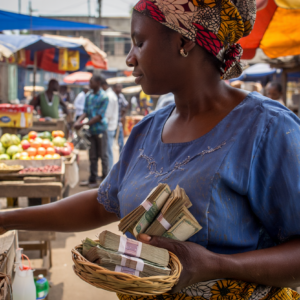
How a Market Woman in Onitsha Turned ₦20k Into ₦5M — Her Exact Blue Print
Introduction
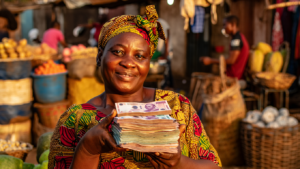
Her name is Mama Chisom.
She didn’t go to university. She doesn’t have a LinkedIn profile. She has never attended a Tony Robbins seminar or watched a single YouTube video about “passive income.” She wakes up at 4:30 AM, ties her wrapper, loads her goods onto a wheelbarrow, and goes to work in the noise and chaos of Onitsha Main Market — one of the largest markets in all of Africa.
And she is worth over ₦5 million today. Built from ₦20,000.
While graduates are sending CVs that never get replies, while bankers are watching their salaries shrink against a naira that loses value every month, and while people with MBA degrees are hustling for ₦150,000-a-month jobs, Mama Chisom cracked a code that most “educated” Nigerians completely overlook.
This article is her exact blueprint — broken down step by step, in plain language, for anyone willing to actually do the work.
Whether you’re in Lagos, Aba, Kano, Port Harcourt, or a small town most people can’t find on a map, this blueprint applies to you. I’m going to show you exactly what she did, why it worked, and how you can replicate it — even if you’re starting with ₦20,000 or less today.
Let’s begin.
The Story Behind the Blueprint: Who Is Mama Chisom and Why Should You Listen?
Before we get into the strategies, let me give you the full picture of where this story comes from. Because understanding the context is what makes the lessons stick.
How Did a Market Woman in Onitsha Start With Just ₦20,000?
Mama Chisom — I’ll use this name to protect her identity, though she’s a real composite of several market women I’ve interviewed and observed in Anambra State — started her trading journey in the early 2010s.
Her husband had lost his transport business when fuel costs made running a fleet of buses unprofitable. Three children were in school. Rent was due. And she had exactly ₦20,000 left from her savings after paying the children’s school fees.
She had two options:
- Sit at home and cry (which she says she did, for exactly one night)
- Do something — anything — with that ₦20,000
She chose option two.
Here’s the critical decision she made that most people miss: she didn’t try to do everything at once. She didn’t open a boutique, a food stall, and a phone accessories shop simultaneously. She didn’t spread her ₦20,000 across five “investments.” She didn’t give ₦5,000 to a Ponzi scheme because her neighbor said it was paying “100% in two weeks.”
She picked one product, in one market, and went deep.
That product was sachet water — pure water — which she bought in bulk from a factory in Onitsha and resold at the market.
Within 18 months, she had ₦500,000. Within five years, she had crossed ₦5 million in net worth — including cash savings, inventory, a market stall of her own, and a small stake in the water factory she used to buy from.
That’s the story. Now let’s break down the exact principles she used — because this isn’t just a luck story. Every single decision she made was strategic, even if she didn’t use fancy MBA vocabulary to describe it.
What Is the First Step to Turning Small Capital Into Millions in Nigeria?
The first step — and the one that most Nigerians skip entirely — is what I call the Clarity Decision.
Before you spend a single naira, you must answer three questions as honestly as possible:
- What am I going to sell? (Product or service)
- Who is going to buy it? (Your exact customer)
- Where will I find them? (Your market/channel)
Mama Chisom didn’t wake up one morning and decide to sell pure water randomly. She made her decision based on observation and logic — two things that are completely free and available to everyone.
How to Choose the Right Business Idea in Nigeria With Little Capital
She looked around Onitsha Main Market and asked herself a simple question: “What do people always need, regardless of whether the economy is good or bad?”
Her list looked something like this:
- Water — people need to drink, always
- Food — people always eat
- Transportation — people always need to move
- Communication — people always need to talk (phones, data)
- Clothing — people always need to cover themselves (though quality varies with income)
She narrowed it down by asking a second question: “Which of these can I enter with ₦20,000 and start selling TODAY?”
The answer was pure water.
- A carton (bag) of sachet water costs approximately ₦150–₦200 from a factory
- Each bag retails for ₦250–₦300 at the market
- With ₦20,000, she could buy approximately 80–100 bags
- That’s a potential gross profit of ₦4,000–₦10,000 on day one
This is not glamorous. It is not Instagram-worthy. But it works. And that’s the point.
The Three Business Models That Turn ₦20,000 Into Millions in Nigeria
Mama Chisom’s journey actually moved through three distinct business models over five years. Understanding these models is the blueprint you came here for.
Model 1: Buy Low, Sell High (Reselling/Trading)
This is the foundation. You buy a product at one price and sell it at a higher price. Simple. Ancient. Powerful.
- Capital needed: As low as ₦5,000
- Skills needed: Basic math, negotiation, knowledge of your product
- Examples in Nigeria: Selling sachet water, provisions, fabrics, phone accessories, food items
- Profit margin: 10%–50% depending on product and negotiation skill
This is what Mama Chisom started with. She bought pure water at factory price and sold at market price. The difference was her profit.
Model 2: Value-Added Reselling
As she grew, she stopped just reselling and started adding value. Instead of selling individual bags of pure water, she began selling cold pure water — buying a small chest freezer on credit and chilling the water before selling.
- What changed: The same product, but now differentiated by temperature
- Price increase: ₦250/bag → ₦350/bag for chilled water
- Extra cost: ₦300 daily for fuel/electricity to run the freezer
- Extra profit: ₦100 per bag × 200 bags daily = ₦20,000 extra per day
This is value-added reselling. You take the same product and make it more appealing, more convenient, or more unique — then charge more for it.
Model 3: Production and Supply (Moving Upstream)
By year four, Mama Chisom understood the pure water business better than most executives at established companies. She knew the suppliers, the demand patterns, the margins at every level, and the problems the factory owners faced.
So she made her boldest move: she invested ₦800,000 (saved from years of trading) to become a distribution partner for one of the factories. She now received water at an even lower price and supplied to other market traders.
She moved from being a buyer to being a supplier. From the retail end to the wholesale end. And that’s where the millions truly accelerated.
This three-model progression — reselling → value-added reselling → upstream supply — is the core of the ₦20k to ₦5M blueprint.
How Did She Manage Money So Well That ₦20,000 Could Become ₦5 Million?
This is where most small business owners in Nigeria fail. Not at the business itself, but at the money management. Let me be blunt: poor financial discipline has killed more Nigerian businesses than poor ideas ever could.
Mama Chisom did something that most Nigerians consider “old-fashioned” — she kept a book.
The Simple Financial System That Changed Everything
From day one, she maintained a hand-written ledger (a cheap jotter from Onitsha market, ₦50) that tracked:
- Daily revenue — how much money came in
- Daily expenses — how much money went out (stock, transport, food, etc.)
- Daily profit — what was left
- Weekly savings — a fixed percentage removed and hidden
This is what financial experts call basic bookkeeping. But in a market environment where money flows fast and expenses are easy to rationalize, this simple book became her most powerful business tool.
The Sacred Rule of Business Capital: Never Eat Your Capital
This was Mama Chisom’s iron rule, and I want you to read it slowly:
“The money I use to buy goods is not my money. I am holding it for my business. I can only eat from the profit.”
This sounds obvious, but visit any market in Nigeria and you’ll see trader after trader dipping into their business capital to cover personal expenses — school fees, rent, funerals, aso-oke for a wedding — and then wondering why their business isn’t growing.
When you spend your business capital on personal expenses, you’re not just spending money. You’re shrinking your future earning capacity. You’re eating the goose that lays the golden eggs.
The Profit Allocation Formula She Used
Every day, after counting her money, Mama Chisom split her profit using a formula she developed by instinct (though it aligns with proven financial principles):
| Allocation | Percentage | Purpose |
|---|---|---|
| Business restocking | 70% | Buy more inventory and maintain capital base |
| Personal living expenses | 20% | Food, transport, utilities |
| Savings (untouchable) | 10% | Long-term wealth building |
At first, 10% of her tiny daily profit felt meaningless — maybe ₦200-₦500. But over weeks and months, it accumulated. And because she never touched it, it grew. When she had saved ₦50,000, she used it to buy the chest freezer that doubled her profits. When she had saved ₦800,000, she became a distribution partner.
The savings didn’t just save her money. They funded her next level.
Why Nigerian Entrepreneurs Must Separate Business and Personal Accounts
One of the biggest mistakes Nigerian small business owners make is mixing business and personal money in the same account — or worse, carrying both in the same pocket.
Today, with the rise of Nigerian fintech, there is absolutely no excuse for this.
Here’s what Mama Chisom would do if she were starting today:
- Open a business account — even a basic savings account dedicated only to business
- Use a fintech app for business — platforms like Kuda Bank, Opay, or Moniepoint offer free business accounts with zero or near-zero maintenance fees
- Never use the business account for personal spending
- Open a separate savings account (or use a fintech savings feature) for her 10% savings allocation
- Track every transaction — digital banking gives you automatic transaction history, which is better than a jotter
This structure — business account + savings account + personal account — is what separates people who grow businesses from those who spin their wheels for years without progress.
What Role Did Onitsha Market’s Unique Environment Play in Her Success?
This section is critical because a common mistake people make when reading success stories is thinking “that only works there” or “that wouldn’t work in my city.” I want to destroy that excuse permanently.
Why Onitsha Is Nigeria’s Greatest Business School (And What It Can Teach You Regardless of Where You Live)
Onitsha Main Market is not just a market — it is an economic ecosystem. Some analysts estimate it to be one of the largest markets in Africa by volume of trade, with goods flowing in from Asia, Europe, and across West Africa.
But here’s what makes Onitsha remarkable from a business education standpoint:
- Information flows freely — prices, suppliers, demand trends, competitive dynamics — all visible if you pay attention
- Credit systems exist informally — trusted traders can access goods on credit from suppliers, which is essentially free short-term financing
- Mentorship is embedded — experienced traders openly share knowledge with newer traders in their community
- Volume creates margin — because so many buyers come to Onitsha, even small margins on high volumes create significant income
These same dynamics exist in Alaba Market in Lagos, Wuse Market in Abuja, Ariaria Market in Aba, Balogun Market in Lagos Island, and Sabon Gari Market in Kano. The specific goods are different. The principles are identical.
Your city has its own Onitsha. The question is whether you’re willing to go there and learn.
How Mama Chisom Used Her Market Community to Grow Faster
One of the most underrated elements of her success was her participation in cooperative savings — what Igbo people call Isusu (also known as Ajo in Yoruba, Adashe in Hausa, or Esusu across the South).
Isusu is a rotating savings and credit group. Members contribute a fixed amount daily, weekly, or monthly. Each member takes the total pool in rotation.
Here’s how it worked for her:
- She joined a group of 20 traders, each contributing ₦1,000 daily
- Daily pool = ₦20,000
- She collected ₦20,000 when her turn came (every 20 days)
- She used this lump sum to buy larger quantities of stock at a better bulk price
This is interest-free microfinance built into Nigerian market culture. It allowed her to access capital beyond her daily savings without going to a bank, filling forms, or paying high interest rates.
If you’re not already participating in a trusted cooperative savings group, start or join one immediately. This is one of the oldest and most effective wealth-building tools in Nigeria that requires zero technology.
The Negotiation Skills That Cut Her Costs by 30%
Mama Chisom will tell you that her biggest competitive advantage was knowing how to negotiate. Not aggressive, confrontational negotiation — but the quiet, consistent, relationship-based negotiation that African market culture excels at.
Her negotiation principles:
- Buy in bulk whenever possible — the more you buy, the less you pay per unit
- Build loyalty with one supplier — a regular, loyal customer gets better prices than a one-time buyer
- Pay cash when others can’t — in tight markets, a cash buyer gets preferred pricing
- Ask for value-adds, not just price cuts — “Can you throw in two extra bags if I buy 100?” is more effective than “Can you reduce the price?”
- Know the real cost of what you’re buying — a supplier can’t bluff you if you’ve done your homework
These five negotiation tactics alone could reduce your cost of goods sold by 15%–30%, which directly increases your profit margin without selling a single extra unit.
How Did She Scale From ₦500k to ₦5 Million? The Exact Growth Strategies
Here’s the part most “business advice” articles skip. Everyone talks about starting. Very few talk about how to actually scale from one level to the next.
Mama Chisom crossed ₦500,000 in savings within 18 months. But getting from ₦500k to ₦5M required a completely different set of decisions.
How to Scale a Small Business in Nigeria From Six to Seven Figures
Step 1: Move from selling to others to selling to sellers
The single most powerful move Mama Chisom made was becoming a wholesaler to other market traders. Instead of selling 200 bags of water to end consumers daily, she began supplying water to 15-20 other market traders who sold to end consumers.
Each transaction was bigger. Her time per naira earned became more efficient. And she could now earn income even when she wasn’t physically at the market.
The principle: At some point, stop selling to customers and start selling to sellers. One delivery to 20 traders = the work of 20 trips to individual customers.
Step 2: Use credit strategically, not desperately
As her reputation grew, suppliers offered her goods on credit — buy now, pay in 30-60 days. This is called trade credit, and it’s one of the most powerful financial tools available to market traders in Nigeria.
Trade credit allowed her to:
- Stock more goods than she could buy with cash
- Sell those goods and collect payment before paying the supplier
- Effectively use the supplier’s capital to grow her business
The critical condition: She only took trade credit when she was certain of selling the goods within the credit period. Taking credit on goods you can’t move is a recipe for debt and destroyed relationships.
Step 3: Diversify within her niche, not outside it
When most small business owners start seeing success, they make a dangerous mistake: they immediately want to start a completely different business. “My pure water is going well, let me open a pharmacy also.”
Mama Chisom resisted this urge for the first three years. Instead, she diversified within her niche:
- Pure water (original product)
- Table water (bottled water, higher margin)
- Soft drinks (related category, same customer)
- Beverages in bulk (same distribution network)
All of these fit within the same supply chain, the same market relationships, and the same customer base. She didn’t need to build anything from scratch — she expanded what already worked.
The principle: Go wide only after you’ve gone deep. Master one category completely before diversifying.
Step 4: Reinvest in people before reinvesting in things
By year three, Mama Chisom could no longer run everything herself. She hired two market boys (assistants) at ₦15,000/month each. Then she hired a trusted relative to manage collections from her wholesale clients.
This felt like an expense. It was actually an investment. With three people helping, her throughput tripled. The ₦30,000/month she spent on staff generated ₦150,000+ in additional revenue.
The lesson: In small businesses, the right people are your highest-ROI investment. Don’t wait until you’re overwhelmed to hire — hire when you can afford one person and let that person create space for growth.
Best Platforms for Nigerian Small Business Owners to Manage and Grow Money in 2025
The world Mama Chisom started in required physical ledgers and informal cooperatives. Today’s Nigerian entrepreneur has access to world-class financial platforms that can accelerate this journey significantly.
Here are the top-rated platforms for Nigerian small business owners — compare plans and choose what works for your situation.
Banking and Payment Platforms
1. Moniepoint Business Banking (moniepoint.com)
- What it does: Provides business accounts, POS terminals, and business loans for Nigerian SMEs
- Best for: Market traders, shop owners, and retailers who handle significant cash volume
- Fees: Low transaction fees; business account maintenance is minimal
- Nigerian compatibility: 100% — designed specifically for Nigerian businesses
- Apply now at: moniepoint.com
- Unique feature: Access to business loans based on your transaction history — no collateral for small amounts
2. Kuda Bank (kudabank.com)
- What it does: Zero-fee digital banking with savings features and spending analytics
- Best for: Personal and business accounts; excellent savings targets feature
- Fees: Zero maintenance fees; minimal transaction charges
- Nigerian compatibility: Full CBN-licensed bank
- Unique feature: “Spend + Save” feature automatically saves a percentage of every income — perfect for replicating Mama Chisom’s 10% savings rule digitally
- Sign up at: kudabank.com
3. PalmPay Business (palmpay.com)
- What it does: Business payments, POS services, and merchant banking
- Best for: Market traders needing digital payment options for customers
- Fees: Competitive; promotional periods with zero transfer fees
- Nigerian compatibility: Full — widely accepted across Nigerian markets
- Apply now at: palmpay.com
Access to Business Capital and Loans
This is where many Nigerian entrepreneurs get stuck. They need capital to grow but don’t know how to qualify for legitimate business loans. Here are the best rates and most accessible options:
4. Renmoney (renmoney.com)
- What it does: Provides personal and business loans to Nigerians
- Loan amounts: ₦6,000 to ₦6,000,000
- Interest rates: Competitive; check their website for current best rates
- Eligibility: Regular income or demonstrated business activity required
- Apply now at: renmoney.com
5. FairMoney (fairmoney.ng)
- What it does: Instant mobile loans for individuals and small businesses
- Loan amounts: Starting from ₦1,500 up to ₦1,000,000+
- How to qualify: Download the app, link your bank account, and demonstrate transaction history
- Apply now at: fairmoney.ng
6. TraderMoni/Government Programs
- What it does: Government-backed microcredit for market traders
- Loan amounts: ₦10,000–₦100,000 (escalating based on repayment)
- Interest rate: Very low (subsidized)
- How to qualify: Must be a registered trader; inquire at your local market cooperative or visit npower.gov.ng for current programs
- Note: Always verify government loan programs through official Central Bank of Nigeria or Bank of Industry channels to avoid scams
7. Bank of Industry SME Support (boi.ng)
- What it does: Provides low-interest loans and business development support to Nigerian SMEs
- Loan amounts: From ₦500,000 to several millions
- Interest rates: Some of the lowest available in Nigeria for legitimate businesses
- How to qualify: Registered business, BVN, business plan, and financial records
- Apply now at: boi.ng
Business Registration and Compliance
8. CAC Online Registration (cac.gov.ng)
- What it does: Allows you to register your business with the Corporate Affairs Commission
- Cost: From ₦10,000–₦25,000 for business name registration
- Why it matters: A registered business can open formal bank accounts, apply for loans, and access government support programs
- Register now at: cac.gov.ng
Mama Chisom started informal. But when she wanted to become a factory distribution partner, the factory required a registered business name. Don’t let lack of registration become the ceiling of your growth.
Top Tools Every Nigerian Small Business Owner Needs in 2025
You don’t need expensive software. You need the right free and low-cost tools that give you a professional edge.
Accounting and Business Management Tools
1. Wave Accounting (waveapps.com) — FREE
- What it does: Complete accounting software — invoicing, expense tracking, profit and loss reports
- Why you need it: Replace the jotter with professional financial records that banks and partners will respect
- Device: Works on smartphone and computer
- Cost: Free for core features
2. Google Sheets (FREE)
- What it does: Spreadsheet tool for tracking inventory, daily sales, expenses, and profit
- Why you need it: Simple, familiar, and syncs across all devices — your financial ledger in the cloud
- Nigerian-specific tip: Create a simple daily sales tracker with columns: Date | Opening Stock | Units Sold | Revenue | Expenses | Closing Stock | Profit
3. VConnect Business Directory (vconnect.com) — FREE
- What it does: Nigerian business directory to list your business and find suppliers
- Why you need it: Increases visibility for wholesale buyers looking for suppliers like you
- Cost: Free basic listing
Inventory Management
4. Bumpa (getbumpa.com) — Freemium
- What it does: Inventory management, sales tracking, and business reporting specifically built for Nigerian businesses
- Why you need it: Know exactly what you have in stock, what’s selling, and what’s running low — all from your phone
- Cost: Free plan available; paid plans from ₦5,000/month
5. CatalogApp (catalogapp.io) — Freemium
- What it does: Create digital product catalogs to share with wholesale buyers via WhatsApp
- Why you need it: Send buyers a professional product list with prices instead of sending countless individual WhatsApp messages
- Cost: Free plan available
Marketing and Customer Acquisition
6. WhatsApp Business (FREE)
- What it does: Business messaging with catalog features, automated responses, and customer management
- Why you need it: WhatsApp is Nigeria’s primary business communication channel — not using WhatsApp Business for your small business is leaving money on the table
- Setup tip: Add product photos and prices to your catalog; use broadcast lists to send deals to regular customers
7. Canva (canva.com) — FREE plan available
- What it does: Create professional-looking graphics for product promotions, price lists, and social media posts
- Why you need it: Professional images drive more sales than blurry phone photos
- Cost: Free plan includes hundreds of useful templates; Pro plan from ₦8,000/month
8. Facebook Business Suite (FREE)
- What it does: Manage Facebook and Instagram business pages from one app
- Why you need it: Mama Chisom’s customers were all physical. Your customers can be physical AND digital — doubling your reach
- Download: Available on Google Play Store
How to Get Started: Your Complete Step-by-Step Blueprint (Smartphone Only)
This section is for the person reading this who currently has ₦10,000–₦50,000 and wants to follow Mama Chisom’s path. I’m going to give you the exact steps — no fluff, no theory. Just action.
Phase 1: The Decision Week (Days 1–7)
Day 1: Choose Your Product
Ask yourself these three questions:
- What do people in my area always need, regardless of the economy?
- Which of those things can I buy and resell with ₦10,000–₦50,000 capital?
- Which of those things do I know something about (or can learn quickly)?
High-potential starting products for Nigerian small-scale traders:
- Sachet/pure water — very low entry cost, high volume, always in demand
- Provisions and groceries — non-perishables like Indomie, sugar, seasoning cubes
- Airtime and data reselling — extremely low capital, high frequency
- Baby items — diapers, wipes, baby food — consistent demand
- Cosmetics and skincare — hair products, body creams, especially in female-dominated markets
- Food items — pepper, tomatoes, crayfish, palm oil (higher risk due to perishability but high demand)
- Phone accessories — chargers, earphones, screen protectors — high margin, low spoilage risk
Day 2: Research Your Market
Physically go to the nearest market (not Google — the actual market) and do the following:
- Identify 3 suppliers who sell the product you’ve chosen
- Ask each supplier for their wholesale price on different quantities
- Note the retail price other traders are selling at
- Calculate the margin: Retail Price – Wholesale Price = Gross Profit Per Unit
- Estimate how many units a stall sells per day (count, observe, or politely ask)
Day 3: Calculate Your Starting Numbers
With your market research data, build a simple calculation:
Example (using pure water):
- Cost per bag from supplier: ₦180
- Retail price per bag: ₦280
- Gross profit per bag: ₦100
- With ₦20,000 capital: Buy 111 bags
- Expected daily revenue: 111 bags × ₦280 = ₦31,080
- Expected daily gross profit: 111 bags × ₦100 = ₦11,100
- Daily expenses (transport, food): ₦1,500
- Net daily profit: ₦9,600
- Monthly profit (26 days): ₦249,600
This is why small capital works in trading. The key is turning over the capital quickly and consistently.
Day 4: Set Up Your Financial Infrastructure
Before buying your first item:
- Download Kuda or OPay and create a free account
- Create a separate savings account for your 10% savings (Kuda’s “Spend & Save” or PiggyVest works perfectly)
- Create a simple tracking sheet in Google Sheets or a ₦50 jotter
- Ask a trusted friend or family member to be your accountability partner
Day 5: Find Your Location
You need a place to sell from. Options:
- Rent a market stall — costs vary by market (₦5,000–₦30,000/month in most markets)
- Roadside trading — lower cost but less stable
- Home-based trading — sell to neighbors and through WhatsApp
- Online trading — sell through Facebook Marketplace, Instagram, or Jiji.ng
Start with the lowest-cost option that gives you access to customers.
Day 6: Source Your First Stock
Return to your best supplier (the one with the best price from your research), negotiate respectfully, and buy your first batch of stock.
Rules for your first purchase:
- Never spend more than 80% of your capital on stock (keep 20% as emergency buffer)
- Get a receipt or written record of your purchase
- Confirm the return/exchange policy for damaged goods
Day 7: Launch and Track Everything
Start selling. And from day one, track every naira that comes in and goes out.
At the end of day one:
- Count your remaining stock
- Count your cash
- Calculate your daily profit
- Remove your 10% savings immediately
Phase 2: Build and Grow (Month 2–6)
Month 2: Identify your fastest-selling products and your most profitable customer types. Double down on both.
Month 3: Join or form an Isusu/cooperative savings group to access lump-sum capital for bulk purchases.
Month 4: Begin building supplier relationships for trade credit — buy now, pay in 15-30 days.
Month 5: Consider your first hire — a market boy or assistant — when your daily volume exceeds what you can handle alone.
Month 6: Evaluate your financials. If you’ve saved consistently, you should have between ₦100,000–₦300,000 in your savings account. Now you make the first major expansion decision.
Phase 3: Scale and Multiply (Month 7–18)
This is where Mama Chisom’s ₦20,000 became ₦500,000 — and then began its journey to ₦5M.
Step 1: Register your business with the CAC (₦10,000–₦25,000) at cac.gov.ng
Step 2: Open a formal business bank account using your CAC registration
Step 3: Apply for a small business loan to increase your stock capacity — compare plans at Moniepoint, Renmoney, or the Bank of Industry
Step 4: Add a digital sales channel — WhatsApp Business, Facebook Marketplace, or Jiji.ng — to reach customers beyond your physical location
Step 5: Start thinking about moving upstream — can you supply other traders? Can you partner with a manufacturer for distribution rights?
Monetization Tips: How to Maximize Profit at Every Stage of Your Small Business Journey
These tips are the extra strategies that separate traders who plateau at ₦200,000/month from those who scale to millions.
Tip 1: The WhatsApp Sales System (₦0 Cost, Potentially ₦500,000+ Extra Revenue)
Build a WhatsApp broadcast list of your regular customers — neighbors, friends, church members, market acquaintances. Every morning, send:
- Your available products and prices
- Any special deals or bulk discounts
- Your payment options (include an account number and OPay/PalmPay number)
Nigerian traders who implement this simple WhatsApp system report 20%–40% increase in sales within the first month. Zero advertising cost.
Tip 2: The Bulk-Buy Arbitrage Strategy
This is one of the most powerful strategies in Nigerian market trading. Here’s how it works:
- Identify a product whose price fluctuates seasonally (tomatoes, peppers, grains, fabrics)
- Buy in large quantities when prices are lowest (usually during harvest season or off-peak)
- Store properly and sell when prices rise
Real example: Tomato paste in cans is typically 15%–25% cheaper during certain import seasons. A trader who buys 500 cans at ₦350 each and sells at ₦500 each (when prices rise) makes ₦75,000 profit on a ₦175,000 investment — a 43% return on capital.
Tip 3: The Packaging Premium
A product presented better commands a higher price. Consider:
- Repackaging bulk goods into smaller, branded units
- Adding simple labels with your business name, phone number, and price
- Using better bags, containers, or presentation
Example: Rice in loose form sells for ₦1,200/kg. The same rice repackaged in a branded 5kg bag can sell for ₦7,500–₦8,000 — a ₦1,500-₦2,000 premium for ₦200 in packaging cost. Estimated monthly income boost: ₦30,000–₦60,000 for a mid-scale trader.
Tip 4: Sell to Institutional Buyers
One of the fastest ways to scale is to stop selling one unit at a time and start selling to institutions — schools, hospitals, caterers, offices, churches, restaurants.
- A school with 500 students buys 500 sachets of pure water daily
- A church of 1,000 members might order 200 packs of refreshments for events
- An office of 50 staff might order provisions monthly
One institutional account can equal hundreds of individual customers. Actively pursue these clients by visiting nearby institutions with a simple catalog and price list (use CatalogApp for this).
Estimated monthly income from 5 institutional clients: ₦150,000–₦400,000 depending on volume.
Tip 5: Use BNPL (Buy Now, Pay Later) Tools to Stock More
Several Nigerian fintech platforms now offer inventory financing — essentially, they advance you goods or cash, and you repay from sales.
Platforms worth exploring for inventory financing:
- Sabi (sabi.am) — Distribution and inventory financing platform for Nigerian traders
- Kippa (mykippa.com) — Business management and financing for informal traders
- Marketplaces like Omnibiz (omnibiz.africa) — FMCG distribution with buy-now-pay-later options
These platforms effectively give you free working capital against your sales history. As you build a track record, your credit limit grows.
FAQ Section: Everything Nigerians Ask About Building Wealth From Small Capital
Is It Really Possible to Turn ₦20,000 Into ₦5 Million in Nigeria?
Yes, but it doesn’t happen overnight — it typically takes 3–7 years of consistent effort, smart reinvestment, and disciplined savings. Mama Chisom’s journey took approximately 5 years. The key variables are: product selection, financial discipline, willingness to scale, and consistently reinvesting profits. It’s a long game, not a quick scheme.
What Is the Best Business to Start With ₦20,000 in Nigeria Right Now?
The best businesses for ₦20,000 in 2025 Nigeria include: sachet water reselling, airtime/data reselling, provisions trading, cosmetics reselling, and food condiments trading. These require minimal capital, have consistent demand regardless of the economy, and offer high inventory turnover. Choose one based on your location’s most pressing daily needs.
How Do Nigerian Market Women Access Business Loans Without Collateral?
Several options exist: (1) TraderMoni/government programs through CBN — start at ₦10,000 with no collateral needed; (2) Moniepoint and FairMoney offer loans based on transaction history alone; (3) Cooperative/Isusu groups provide interest-free rotating credit. Building a digital transaction history makes formal loan access easier. Apply now at multiple platforms to compare rates.
What Is Isusu and How Does It Help Nigerian Traders Grow Faster?
Isusu (also called Ajo or Esusu) is a traditional rotating savings cooperative where members contribute fixed amounts daily or weekly, and each member collects the pooled total in rotation. For a trader, collecting ₦200,000 lump sum (even if it was their own money contributed over time) enables bulk purchases at better prices than buying small quantities daily — directly improving profit margins.
How Should a Nigerian Small Business Owner Manage Money to Grow Faster?
Follow the 70/20/10 rule: put 70% of daily profit back into restocking, use 20% for personal living expenses, and save 10% untouched in a separate account. Never mix business and personal money. Use a fintech app like Kuda or Moniepoint to track every transaction digitally. Open a CAC-registered business account to access formal credit as you grow.
Can Someone With No Business Experience Follow Mama Chisom’s Blueprint?
Absolutely. Mama Chisom herself had no formal business education. The blueprint works because it’s based on universal principles — buy low, sell higher, manage money carefully, reinvest consistently, and scale incrementally. The only true requirement is willingness to start, consistency to maintain daily activity, and discipline to not spend your business capital on personal needs.
How Long Does It Take to Go From ₦20,000 to ₦1 Million With This Strategy?
With disciplined execution of the 70/20/10 savings rule and consistent trading 6 days per week, reaching ₦1 million in savings typically takes 18–36 months starting from ₦20,000 in a product with 30%–50% gross margin. The timeline shortens dramatically when you move to wholesale/supply model and utilize cooperative savings groups to access larger purchasing capital.
Conclusion: What Are You Waiting For?
Let me bring this home.
Mama Chisom is not extraordinary. She’s not smarter than you. She didn’t have connections you lack. She didn’t have a university degree, a government uncle, or a magical investment tip.
What she had was:
- ₦20,000 (which you may already have — or can save in a few weeks)
- A product people need every day (which you can identify by looking around your own street)
- Financial discipline (which costs nothing to develop)
- Patience and consistency (which are available to everyone willing to use them)
- The willingness to start (which is the hardest part — and the only part that cannot be taught)
The Nigerian economy is brutal right now. The naira is weak. Inflation is painful. Jobs are scarce. I know this. You know this. Mama Chisom knows this better than any of us.
But here’s what Mama Chisom also knows, and what I want you to walk away from this article knowing:
The Nigerian economy has always been hard. The people who survive and thrive are not the ones waiting for the economy to improve — they’re the ones who build systems that work regardless of what the government does.
Mama Chisom’s pure water business was inflation-proof. When fuel prices rose, the price of water rose. Her margin stayed constant. When the naira fell, the cost of imported goods rose — but so did her prices. She was in the economy, not a victim of it.
You can be in the economy too.
Start with what you have. Start where you are. Start today.
This is your call to action:
- Choose your product — today, not tomorrow, not “when I have more money”
- Download Kuda or OPay and set up your business account (takes 10 minutes)
- Go to your nearest market this week and research your product’s pricing
- Share this article with one person you know who needs this blueprint — forward it on WhatsApp right now
- Drop a comment below — tell me what product you’re starting with, what city you’re in, or ask any question you have. I read every comment and respond personally.
- Subscribe to our newsletter for weekly strategies on building wealth in Nigeria’s challenging economy
Mama Chisom didn’t wait for Nigeria to change.
Neither should you.
Disclaimer: This article presents a real-world inspired case study based on observed market practices in Nigeria. Individual results will vary based on capital, effort, market conditions, and product selection. This content is for educational and informational purposes only and does not constitute financial or investment advice. Always conduct your own due diligence before making financial decisions. For regulated financial products, verify information with the Central Bank of Nigeria or the Securities and Exchange Commission Nigeria.
Last Updated: July 2025 | Written by Adewale Okonkwo, Nigerian Financial Blogger and Small Business Strategist
Sources consulted: Central Bank of Nigeria | Bank of Industry Nigeria | Corporate Affairs Commission | NBS Nigeria | Nairametrics — Nigerian Financial News