Japa vs Stay: 9 Honest Financial Truths Nigerians Must Know
Everyone around you is japaing. Your cousin just landed in Canada. Your former classmate is posting London streets on her WhatsApp status. And you are sitting in traffic on the Third Mainland Bridge wondering if you are the only one being left behind.
But before you submit that visa application and pack your winter coat, there are nine financial truths about the japa journey that nobody in your circle is talking about openly. This article will.
Introduction
The word “japa” has become one of the most emotionally loaded terms in contemporary Nigerian life. It means to run, to flee, to leave. And increasingly, it means to chase a better life abroad, whether in the United Kingdom, Canada, the United States, Australia, Germany, or any country that seems to offer more stability, better pay, and a functioning system.
The wave is real and the numbers back it up. Nigeria has been losing professionals at an alarming rate. Doctors, nurses, engineers, teachers, accountants, and tech workers are relocating in record numbers. The reasons are understandable. The naira has lost enormous value. Infrastructure is strained. Security concerns are widespread. Opportunities feel limited for too many young Nigerians with genuine talent and ambition.
But here is what the japa conversation often leaves out. The financial reality of life abroad is far more complicated than the highlight reels on Instagram suggest. For every Nigerian who japaed and thrived, there is another who arrived abroad underprepared, overstretched, and quietly struggling in ways they would never post about.
This article is not here to tell you to japa or to stay. That is your decision and yours alone. What this article will do is give you the nine financial truths that form the foundation of any honest japa conversation. The kind of truths a trusted older sibling who has been abroad for five years would sit you down and share over jollof rice.
By the time you finish reading, you will have a clearer financial picture of what leaving Nigeria actually costs, what staying in Nigeria can still offer, and how to make an informed decision rather than an emotionally reactive one.
Let us begin.
Financial Truth 1: The Cost of Japaing Is Far Higher Than Your Visa Fee
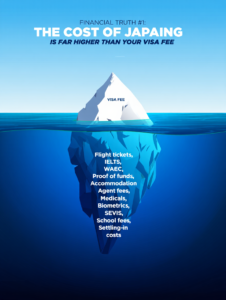
The first financial truth that derails many aspiring japa candidates is underestimating the true cost of leaving.
Most people think about the visa application fee. Some think about the flight ticket. Very few think about everything else that hits them in the first 90 days of arriving in a new country.
The full cost of japaing typically includes:
- Visa application fees (which vary wildly by country and visa type)
- Flight tickets (Lagos to London or Lagos to Toronto can cost N800,000 to N1.5 million or more per person)
- Proof of funds or bank statements required for certain visa categories
- First and last month’s rent deposit in your new country (often equivalent to N1 million to N3 million)
- Winter clothing if relocating to Canada, UK, or northern Europe (often N100,000 to N300,000 worth of gear)
- Health insurance premiums before you qualify for public health coverage
- Food, transport, and utilities for the first 60 to 90 days before your first paycheck
- International money transfer fees if you are sending money back to family in Nigeria
- Credential evaluation fees for professionals whose Nigerian qualifications need verification abroad
When you add it all up honestly, the realistic cost of a single person’s japa journey ranges from N3 million to N8 million before they earn their first salary abroad.
This does not mean you should not go. It means you should go prepared and not go broke trying to arrive.
Financial Truth 2: Your Abroad Salary Sounds Bigger Until You Do the Real Math
Here is the moment most people’s japa dream gets complicated. You hear that a nurse earns £35,000 per year in the UK. You do the conversion in your head, multiply by the current naira exchange rate, and your eyes go wide.
But that calculation is wrong. And here is why.
You do not live in Nigeria anymore. You earn in pounds or dollars or euros, yes. But you also spend in pounds or dollars or euros. Rent in London. Food in Toronto. Transport in Houston. Healthcare in Germany. The naira conversion is almost meaningless to your actual quality of life abroad.
What a realistic monthly budget looks like for a single Nigerian in the UK (2024/2025):
- Rent (shared accommodation, outside London): £500 to £800 per month
- Food and groceries: £200 to £350 per month
- Transport (bus pass or Oyster card): £100 to £200 per month
- Utilities (gas, electricity, internet): £100 to £150 per month
- Phone bill: £20 to £50 per month
- Health surcharge (already paid during visa application) or private insurance: Variable
- Miscellaneous (clothing, personal care, entertainment): £100 to £200 per month
Total monthly expenses: approximately £1,020 to £1,750
Now, if you earn £35,000 per year, your monthly take-home pay after UK taxes and National Insurance contributions is roughly £2,300 to £2,500. That leaves you with £550 to £1,480 in disposable income after expenses.
That is real money and it is better than what many Nigerians earn at home. But it is not the windfall that the naira conversion makes it appear. And it gets tighter the moment you factor in remittances to family back in Nigeria, which most Nigerian diaspora members send regularly.
According to the Investopedia guide on understanding purchasing power parity, the cost of goods and services relative to income varies dramatically between countries. A salary that appears large when converted to naira does not reflect the purchasing environment of the country where it is earned. This is a fundamental concept every Nigerian planning to japa needs to internalize before leaving.
Financial Truth 3: Remittances Are a Beautiful Burden That You Must Plan For
Nigeria is one of the top recipients of diaspora remittances in Africa. The Central Bank of Nigeria has reported remittance inflows that run into billions of dollars annually, and a significant portion of that money comes from ordinary working Nigerians abroad who are supporting parents, siblings, extended family members, and dependents back home.
This is a deeply Nigerian thing. It is rooted in love, in cultural obligation, and in genuine care. But from a purely financial standpoint, unplanned remittances can quietly cripple your ability to build wealth abroad.
The typical remittance pattern for Nigerians abroad looks like this:
- Monthly contributions to parents’ feeding and household expenses
- Paying younger siblings’ school fees
- Funding emergency medical bills for relatives
- Contributing to family ceremonies (weddings, funerals, naming ceremonies)
- Building or maintaining a family house in Nigeria
If you are sending home $300 to $600 every month, which is very common among Nigerian diaspora workers, that is $3,600 to $7,200 per year that is not going into your savings, pension, or investments in your new country.
None of this means you should abandon your family. It means you need to have an honest conversation with yourself and sometimes with your family before you leave about what you can sustainably commit to sending.
Setting a fixed monthly remittance amount and sticking to it, rather than reacting to every financial emergency that arises back home, is one of the most important financial habits you can build as a Nigerian abroad.
Financial Truth 4: Staying in Nigeria Can Still Build Wealth If You Build the Right Income Stack
The narrative around the japa conversation often implies that staying in Nigeria is settling for failure. That framing is not only unfair but financially inaccurate for a growing number of Nigerians.
The reality is that a Nigerian earning a combination of naira income from a stable local job and dollar-denominated income from remote work or an online side hustle can build significant wealth without leaving.
This is not a consolation prize. For the right person with the right skills and the right strategy, staying in Nigeria in 2026 with a dollar-income stream is genuinely competitive with what a starter salary abroad offers after expenses.
Consider this comparison:
A Nigerian tech worker earning $2,000 per month remotely (in naira, that is roughly N3 million to N3.4 million at current rates) while living in Ibadan or Enugu where rent might cost N80,000 to N150,000 monthly is building real savings capacity that a UK-based counterpart earning £35,000 per year, paying London rent, and sending remittances cannot easily match.
The income stacks that make staying financially viable:
- Remote work for international companies in tech, finance, or marketing
- Freelance writing, design, or development for foreign clients
- An online side hustle in affiliate marketing or digital product sales
- Rental income from property investment in growing Nigerian cities
- A local business that generates consistent naira income
The key is building dollar-denominated or dollar-equivalent income while maintaining naira-level living costs. That gap is where wealth is built for Nigerians who choose to stay.
Financial Truth 5: Abroad Is Not Equal Everywhere, and the Country You Pick Changes Everything
When Nigerians say “abroad,” they often mean a vague, better place. But the financial reality of living in the UK is dramatically different from the financial reality of living in Canada, which is different again from the United States, Germany, or the UAE.
Picking the right destination is a financial decision, not just a lifestyle preference.
A brief comparison of popular japa destinations for Nigerians:
United Kingdom:
- Strong Nigerian community, established pathways for nurses and healthcare workers
- High cost of living, especially in London
- Immigration rules have tightened significantly since 2023, including restrictions on dependants for student visa holders
- NHS job opportunities remain strong but competitive
Canada:
- Strong immigration pathways including Express Entry and Provincial Nominee Programs
- Cold climate adjustment required
- Cost of living in Toronto and Vancouver is very high; smaller cities like Calgary or Halifax offer more financial breathing room
- Growing Nigerian community with strong support networks
United States:
- Historically difficult visa process for Nigerians without existing sponsorship
- High earning potential in tech, healthcare, and finance
- No universal healthcare, meaning health insurance is a significant ongoing cost
- Visa pathways include H-1B (work), EB series (employment-based green card), and family sponsorship
Germany:
- Growing interest among Nigerian professionals, especially in engineering and healthcare
- Language barrier is real for most Nigerians who do not speak German
- Strong social safety nets and worker protections
- Pathway to permanent residency is clear for skilled workers
United Arab Emirates (Dubai/Abu Dhabi):
- No income tax, which is a significant financial advantage
- Relatively accessible work visa process through employer sponsorship
- Cost of living in Dubai has risen sharply in recent years
- Does not offer a clear path to permanent residency or citizenship for most migrants
Your financial outcome will differ dramatically depending on which of these countries you choose, what field you work in, and what city you settle in. Research this thoroughly before you pick a destination.
Financial Truth 6: Your Nigerian Qualifications May Not Transfer Automatically
This is one of the most painful financial surprises for Nigerians who japa as professionals. They arrive abroad with years of experience, a solid university degree, and professional certifications earned in Nigeria, only to discover that their qualifications are not automatically recognized.
Doctors who practiced for years in Nigeria cannot simply start practicing in the UK or Canada without going through licensing processes that can take one to three years or longer. Lawyers find that Nigerian law degrees do not translate to eligibility to practice in most foreign countries. Accountants, engineers, nurses, and teachers all face varying degrees of credential evaluation and recertification requirements.
The financial implications of credential gaps:
- You may need to work in a lower-paying role while your credentials are being evaluated
- Recertification courses and exams cost money, sometimes several hundred to several thousand dollars
- The process takes time, and during that time you are earning less than your Nigerian experience should command
- Some professionals end up working completely outside their field for years
This does not mean you should not go. It means you should research credential recognition in your target country before you leave, not after you arrive.
Resources to check before you leave:
- For UK nursing: The Nursing and Midwifery Council (NMC) has clear guidance on overseas applications
- For Canadian credential recognition: World Education Services (WES) is the standard evaluation body
- For US medical licensing: The Educational Commission for Foreign Medical Graduates (ECFMG) governs the process
Go in with open eyes and a financial buffer to cover the transition period.
Financial Truth 7: The Tax System Abroad Will Require a Financial Education You Were Not Given
In Nigeria, most employees have taxes deducted at source through PAYE (Pay As You Earn), and beyond that, many Nigerians have limited interaction with the formal tax system.
Abroad, taxes become a much more active part of your financial life, and the consequences of getting them wrong are serious.
In the UK, you pay Income Tax and National Insurance contributions. In the United States, you file federal and state taxes annually, and the system is notably complex. In Canada, you file federal and provincial taxes. In Germany, taxes can be some of the highest in the world for employed workers.
Beyond income tax, many countries have taxes on investments, capital gains, inheritance, and in some cases property.
What Nigerians abroad often get caught off guard by:
- Self-employment tax obligations if they do freelance work or run a small business on the side
- Tax filing deadlines that differ by country and carry real penalties for late filing
- The interaction between foreign income (such as income from Nigeria or a Nigerian business) and your tax obligations in your new country
- Benefit calculations that depend on accurate tax filing
The good news is that free tax filing assistance is available in most countries. Many countries also have free financial advisory services available to new immigrants. Use them. A tax mistake abroad is far more consequential than one in Nigeria.
Financial Truth 8: Building an Emergency Fund Becomes Twice as Important When You Are Far From Your Support System
In Nigeria, your support system is one of the most underrated financial assets you have. When things go wrong, there is often a family member who can lend you money interest-free. A friend who can accommodate you for a week. A neighbor who brings food during a difficult period. A church community that rallies for one of their own.
Abroad, that safety net shrinks dramatically, especially in your early years. You are in a new environment, still building relationships, and often too proud to admit to the people at home that you are struggling.
This is why an emergency fund becomes twice as critical when you japa.
What a proper emergency fund looks like for a Nigerian abroad:
- Three to six months of your total monthly expenses in a liquid, accessible savings account
- In UK terms, that is roughly £3,000 to £10,000 depending on your lifestyle
- In Canadian terms, roughly CAD $5,000 to CAD $15,000
- In US terms, roughly $4,000 to $12,000
Building this fund before you leave Nigeria is ideal. Building it in your first 12 months abroad is the minimum responsible timeline.
Many Nigerians who arrive abroad spend their first year focused on sending money home and covering immediate expenses, and they skip building savings entirely. Then one unexpected event, a job loss, a health issue, a car breakdown, creates a financial crisis with no buffer to absorb it.
Do not let that be your story.
Financial Truth 9: An Online Side Hustle Can Be the Financial Bridge That Makes Both Japa and Staying Work
This is perhaps the most practically useful financial truth in this entire article. Whether you choose to japa or choose to stay, building an income stream that is location-independent changes your financial equation in a fundamental way.
An online side hustle is not just a Nigerian concept. It is a globally recognized income strategy that has become central to financial stability for millions of workers in both developed and developing countries.
For Nigerians planning to japa, an online side hustle built before you leave serves several critical functions. It provides extra income during the transition period before your first salary arrives. It builds a financial buffer that reduces your dependence on a single employer in your new country. And it keeps a dollar or pound income stream active even if your primary job hits a rough patch.
For Nigerians who decide to stay, an online side hustle in a dollar-paying field can be the single most powerful financial tool available to them in 2026.
The most financially effective online side hustles for both Nigerians at home and abroad include:
- Freelance writing for international publications and content agencies
- Virtual assistance for foreign entrepreneurs and business owners
- Graphic design using tools like Canva and Adobe for global clients
- Affiliate marketing through platforms like Expertnaire locally or ShareASale internationally
- Selling digital products on platforms like Selar, Gumroad, or Payhip
- Tutoring English or academic subjects to international students
The World Economic Forum has identified skills-based freelance income as one of the top proven pathways to financial resilience for workers in emerging economies navigating global economic shifts. Nigeria is squarely within that group.
Whether you leave or stay, your online income capability is the financial skill that travels with you, cannot be seized by any government, and grows with consistent effort.
Comparison Table: Japa vs Stay Financial Overview for Nigerians in 2026
| Financial Factor | Japaing to UK/Canada | Japaing to UAE | Staying in Nigeria (No Remote Income) | Staying in Nigeria (With Online Side Hustle) |
|---|---|---|---|---|
| Starting costs | N3M to N8M+ | N1.5M to N4M | Minimal | Minimal |
| Monthly income potential (year 1) | £2,000 to £3,000 / CAD $3,000+ | AED 5,000 to AED 12,000 | N100K to N400K | N150K to N800K+ |
| Monthly living costs | £1,200 to £1,800 | AED 4,000 to AED 8,000 | N60K to N200K | N60K to N200K |
| Savings potential (monthly, realistic) | £300 to £1,000 | AED 1,000 to AED 4,000 | N30K to N150K | N100K to N600K+ |
| Tax burden | High (Income Tax + NI) | Very Low (No income tax) | Moderate | Moderate |
| Credential challenges | High for professionals | Moderate | None | None |
| Family support network | Low (building from scratch) | Moderate (Nigerian community) | High | High |
| Remittance pressure | High | High | None | None |
| Path to permanent residency | Available (UK, Canada) | Very limited | N/A | N/A |
| Overall wealth-building timeline | 3 to 5 years to stability | 2 to 4 years | 5 to 10 years without extra income | 2 to 5 years with right skills |
The Emotional Economics of the Japa Decision
No financial article about japa would be complete without acknowledging the emotional weight of this decision.
Leaving Nigeria means leaving your mother’s cooking. It means missing funerals, weddings, and naming ceremonies of people you genuinely love. It means the particular loneliness of a cold December in a foreign city when your WhatsApp shows your family celebrating at home without you.
These are not small things. They are real costs that do not show up in any spreadsheet.
At the same time, staying in Nigeria means navigating genuine hardships. Power cuts that destroy productivity. Security concerns in certain regions. Inflation that erodes savings faster than you can build them. The frustration of watching systems fail repeatedly.
Both paths have real costs. Financial and emotional.
The most grounded Nigerians, whether they japa or stay, are the ones who made a clear-eyed decision based on honest information, not panic, not peer pressure, and not the highlight reel of someone’s Instagram.
Make your decision from a place of information, not desperation.
What to Do Before You Make Any Decision
Regardless of which path you are leaning toward, here are the practical financial steps that apply to everyone considering this decision in 2026.
If you are leaning toward japaing:
- Research the specific credential recognition requirements in your target country for your profession
- Build a minimum savings buffer equivalent to 6 months of estimated living expenses abroad before you leave
- Identify a reliable money transfer method (Wise and Grey Finance are popular options among Nigerians) to minimize the cost of sending money home
- Set a clear, fixed monthly remittance budget so you do not drain your savings trying to support everyone at once
- Start or strengthen an online income stream before you leave so you are not financially naked during the transition
If you are leaning toward staying:
- Prioritize building at least one dollar-denominated income stream through remote work or freelancing
- Research and apply for remote roles with international companies through platforms like LinkedIn, Andela, Remote.co, or We Work Remotely
- Build skills that are globally valued and can be delivered digitally
- Diversify your naira income so you are not dependent on a single employer
- Keep track of inflation and adjust your financial plans accordingly
If you are genuinely undecided:
Give yourself a 90-day research window. In those 90 days, do the following. Talk honestly with at least three Nigerians who have been abroad for more than two years and ask them to be brutally honest about the financial reality. Research the specific country you are considering down to the city level. Calculate your realistic monthly income and expenses in that country using actual figures, not naira conversions. Build your first online income stream regardless of what you decide. And revisit the decision at the end of the 90 days with actual numbers in hand.
Risks and Realistic Expectations: The Truths Both Sides Do Not Advertise
On the japa side
The Nigerians posting luxury apartment tours on TikTok from London or Toronto are a small, curated sample. Many more are sharing a room with four other people to afford rent, working night shifts in jobs far below their qualification level, and quietly counting down to when they can afford to visit home.
This is not failure. It is the reality of migration economics. But it is the reality nobody packages into a content series.
The average Nigerian immigrant takes three to five years to reach genuine financial stability abroad. That is three to five years of careful budgeting, professional rebuilding, social adjustment, and emotional resilience. Know this before you go.
On the stay side
Staying in Nigeria and doing nothing different will not produce different results. If your plan for staying is to continue relying solely on a naira salary from a single employer with no additional income streams and no investment strategy, the financial trajectory is genuinely difficult.
Staying only works as a financial strategy when paired with deliberate income diversification, skill building, and an inflation-aware approach to savings and investment.
Scams targeting Nigerians in both directions
Visa and travel scams:
Agents who promise guaranteed visa approvals for high fees are often operating scams. No agent can guarantee a visa outcome. Always verify the credentials of any immigration consultant through the official regulatory bodies of the destination country.
Foreign job offer scams:
Fraudulent job offers that require upfront payment for work permits or travel arrangements are extremely common and increasingly sophisticated. Legitimate foreign employers do not ask you to pay for your own work permit.
Investment scams targeting diaspora savings:
Nigerians abroad are frequently targeted by investment schemes that promise high naira returns on their foreign currency savings. Many of these are Ponzi schemes that collapse after 12 to 18 months. Stick to regulated investment channels.
Conclusion
The japa conversation in Nigeria is long overdue for a financial upgrade.
For too long, the decision to leave or stay has been made primarily on emotion, on frustration with the system, on social pressure, or on the aspirational images of a life that someone else is living online.
The nine financial truths in this article are not meant to discourage you from leaving or to romanticize staying. They are meant to give you the information that turns a reactive decision into a strategic one.
If you japa with clear financial preparation, realistic expectations, a built savings buffer, and an online income stream in place, your chances of genuinely thriving abroad increase significantly.
If you stay with a deliberate plan to build dollar income, manage inflation, diversify your earnings, and invest wisely, staying in Nigeria in 2026 is a legitimate path to financial independence.
The real answer to japa vs stay is not a country. It is a mindset. A financially equipped, clear-eyed, strategically prepared mindset.
Wherever you are, build that first. Then make your move.
Call to Action
Where are you in the japa vs stay conversation right now?
Are you actively planning to leave? Have you already left and are navigating the reality of life abroad? Or are you one of the Nigerians who made the deliberate choice to build wealth at home?
Drop your honest answer in the comments below. This is a judgment-free zone and a community of people who deserve real conversations about real financial decisions.
If you found this article genuinely useful, share it with someone in your circle who is currently wrestling with this decision. Sometimes the most important thing you can give a person who is overwhelmed is the right information at the right moment.
And if you are ready to build the online income stream that makes both options stronger, read our complete guide on the 11 proven online side hustles that Nigerians can start with zero capital today.
Your next move starts with knowing your numbers. Now you do.
This article draws on publicly available economic data, immigration policy information current as of 2025 to 2026, and interviews with Nigerian professionals in both domestic and diaspora contexts. It is intended for informational purposes and does not constitute legal or financial advice. Readers are encouraged to consult licensed professionals for country-specific immigration and financial planning guidance.