8 Exact Retail Business Ideas That Work in Lagos Nigeria (High Demand Areas)
You are sitting on one of Africa’s biggest goldmines, and most people walk past it every single day.
Lagos is not just a city. It is a market. A roaring, relentless, 24-hour economy where over 15 million people need things constantly, and someone has to sell those things. That someone could be you.
Introduction: Why Lagos Is a Retailer’s Dream Right Now
Lagos generates roughly 25% of Nigeria’s entire GDP. Think about that for a moment. One city. One-quarter of the national economy. This is not an accident.
The city is a pressure cooker of demand. People are moving in from other states daily. Young professionals are earning salaries and spending them fast. Families are growing. Markets are expanding into new neighborhoods. The middle class, despite economic pressures, still needs to eat, dress, groom, and entertain itself.
Nigeria’s inflation rate has created a difficult environment for salaries. But here is the thing. Inflation rarely kills demand. It shifts it. People stop buying imported luxury goods and start buying local alternatives. They stop eating at restaurants and start buying more food items from neighborhood stores. When the economy squeezes people, smart retailers pivot and profit.
According to data from the National Bureau of Statistics Nigeria, the retail and trade sector remains one of the largest contributors to Nigeria’s GDP outside of oil. That means real money is flowing through retail channels right now.
This article is going to walk you through eight specific retail business ideas that have proven demand in Lagos. Not theory. Not “what might work.” These are businesses you can see operating successfully right now in Yaba, Ikeja, Lekki, Surulere, Oshodi, and beyond.
For each idea, you will learn what the business actually involves, who buys the product, how much startup capital is realistic, where to set up, and what your monthly earning potential looks like. By the end, you will know exactly which idea fits your budget, your lifestyle, and your ambition.
Let us get into it.
1. Retail Business Idea: Selling Groceries and Food Staples in High-Traffic Neighborhoods
What This Business Actually Looks Like
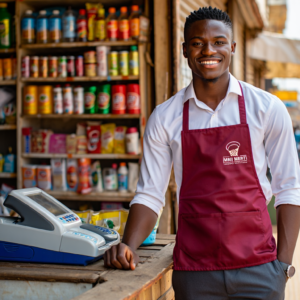
Grocery retail is not glamorous. But it is consistently profitable, and Lagos makes it especially so. This involves selling everyday food items including rice, beans, garri, tomatoes, peppers, onions, palm oil, groundnut oil, seasoning cubes, crayfish, and similar staples.
You can operate from a physical stall in a local market, a container shop in a residential estate, a kiosk at the entrance of a compound, or even a structured table-top setup near a bus stop. The format matters less than the location.
Why This Is One of the Most Reliable Retail Business Ideas in Lagos
People eat every day. That sentence is so obvious it almost sounds stupid, but it is the entire business case. Unlike phone accessories or fashion items, food has zero discretionary element. Nobody wakes up and decides not to eat because money is tight.
Lagos neighborhoods like Agege, Mushin, Ketu, Bariga, and Festac have dense residential populations with working-class households that shop daily or every two to three days. They buy in small quantities because they cannot afford bulk storage. This means frequent repeat transactions.
Key success factors:
- Location near residential clusters, not commercial hubs
- Fresh produce availability and daily restocking
- Friendly, familiar customer relationships (most buyers become regulars)
- Competitive pricing on staple items like rice and oil
- Flexible packaging (selling by cups, handfuls, or small wraps)
Realistic Income Potential
A well-placed grocery kiosk in a busy Lagos neighborhood can generate between 150,000 and 400,000 naira in monthly sales. Profit margins on staples average between 15% and 25%, meaning net earnings of roughly 25,000 to 100,000 naira monthly depending on volume and location quality.
Startup capital ranges from 50,000 to 200,000 naira depending on whether you already have a space or need to rent one.
2. Profitable Retail Business: Phone Accessories and Charging Solutions
The Demand That Never Slows Down
Lagos has one of the highest smartphone penetration rates in West Africa. Walk into any bus, market, or office, and nearly everyone is staring at a screen. Those screens need cases. They need chargers. They need screen protectors, earphones, power banks, and USB cables.
Phone accessories retail is a high-volume, fast-moving business. Items are affordable for buyers, easy to source from Ikeja Computer Village or wholesale markets in Lagos Island, and have excellent markups.
Where to Position This Retail Business in Lagos
The best locations for phone accessories retail are:
- Near universities and polytechnics (Unilag environs, LASU axis, Yaba College area)
- Inside shopping malls like Ikeja City Mall or Surulere markets
- Near mobile network recharge card sellers (co-locate for foot traffic)
- On busy pedestrian streets in Oshodi, Ojuelegba, or Maryland
A simple table display or a small kiosk works perfectly for starting out. You do not need a full shop to begin. Many successful Lagos phone accessory retailers started with a foldable table and a security chain.
What You Need to Know About Margins
Earphones bought wholesale at 800 naira can retail for 2,000 to 2,500 naira. Screen protectors costing 300 naira wholesale sell for 1,000 to 1,500 naira with installation. Branded phone cases bought at 500 to 700 naira can sell for 1,800 to 2,500 naira.
Startup capital needed: 30,000 to 100,000 naira for initial stock.
Monthly sales potential: 200,000 to 600,000 naira for a well-trafficked location.
Net profit after restocking: 60,000 to 180,000 naira monthly.
3. Lagos Retail Market Opportunity: Skincare and Beauty Products
Why Beauty Retail Is Booming Across Lagos
Lagos women (and increasingly, Lagos men) are serious about their appearance. The beauty industry in Nigeria has exploded over the last decade. Local and international skincare brands have multiplied. Social media has made beauty routines aspirational and accessible to everyday consumers.
The demand spans multiple price points. Affordable skincare for working-class buyers. Mid-range products for the Lekki and Victoria Island crowd. Natural and organic options for health-conscious consumers in upscale areas.
This creates multiple entry points depending on your budget and target market.
How to Structure This as a Retail Business
You can retail beauty products in several ways:
Option A: Physical store or kiosk
Set up in markets like Tejuosho, Balogun, or inside malls. Stock a focused range of skincare and haircare products.
Option B: Home-based retail with social media
Run an Instagram or WhatsApp business page, take orders, and deliver within your local government area. Low overhead, decent volume.
Option C: Market stall combined with online orders
A hybrid that maximizes reach without massive rent commitments.
Popular product categories:
- Body lotions and creams (local and imported)
- Hair care products (wigs, hair extensions, edge control, relaxers)
- Face cleansers, toners, and moisturizers
- Shea butter and natural oils (huge demand right now)
- Makeup and cosmetics
Realistic Startup and Earning Figures
Startup capital: 80,000 to 300,000 naira depending on product range.
Profit margins in beauty retail typically run between 30% and 60% on most items.
Monthly net earnings: 80,000 to 250,000 naira for a steady operation.
Top performers in areas like Lekki Phase 1 or Ikeja GRA with strong social media presence can earn significantly above this range.
4. High-Demand Retail Business in Lagos: Children’s Clothing and School Supplies
A Market Driven by Permanent Demographics
Lagos has a very young population. Millions of children live in this city, and children grow. They outgrow clothes every few months. They need new school uniforms annually. They need backpacks, notebooks, pens, rulers, and stationery every term.
This is not seasonal demand. It is structural demand built into the demographics of the city itself.
Why This Retail Business Idea Thrives in Lagos
Parents cannot avoid spending on their children’s school needs. Even when money is tight, school items are among the last things parents cut. This makes the market relatively recession-resistant.
The back-to-school periods in January, April, and September are peak seasons. Smart retailers build inventory in advance and market aggressively in the two weeks before school resumption. But between those peaks, the business still generates steady daily revenue from walk-in parents.
Best Lagos locations for this business:
- Near primary and secondary schools (directly across or beside the gate)
- In residential markets like Ojodu, Magodo, Ajah, and Gbagada
- Near churches and mosques on Sunday mornings (parents buy after service)
- Inside community shopping complexes
What to stock:
- Children’s casual wear by age group
- School uniforms (customized or standard colors)
- Backpacks and school bags
- Notebooks, pens, rulers, mathematical sets
- Lunch boxes and water bottles
Income and Capital Breakdown
Startup capital: 100,000 to 250,000 naira.
Profit margins: 30% to 50% on clothing, 20% to 40% on stationery.
Monthly earnings during regular months: 60,000 to 150,000 naira.
Monthly earnings during back-to-school periods: 200,000 to 500,000 naira.
5. Retail Business Ideas Lagos Nigeria: Pure Water and Bottled Water Distribution
The Business That Sells Itself Every Single Day
Lagos tap water is not reliably safe for drinking. Everyone knows this. This means bottled water and pure water sachets are not optional purchases. They are survival purchases.
The sachet water market (known as “pure water”) is enormous. Factories produce millions of bags daily, and they need retail distributors to move them to end consumers across every neighborhood.
This retail business works on volume, not margin. Individual margins per bag are small, but the sheer volume of daily sales makes the numbers work.
How the Business Model Works
You typically buy bags of pure water sachets from a factory or a depot at wholesale prices. You then sell them to smaller kiosk owners, roadside sellers, restaurants, offices, and households.
Alternatively, you retail directly at a roadside stand or kiosk to individual buyers.
Some entrepreneurs combine both, doing morning wholesale runs to market sellers and afternoon retail at a fixed point.
Starting this retail business requires:
- A reliable supplier (factory or depot near your area)
- Storage space at home or in a rented space
- A handcart or motorcycle for delivery (optional but useful)
- 30,000 to 80,000 naira starting capital
Earning Potential
This is a high-volume, thin-margin game. A retailer moving 50 to 100 bags of pure water daily can earn between 30,000 and 80,000 naira monthly in net profit.
Distributors who supply multiple retailers and serve institutional clients (restaurants, schools, offices) can scale to 150,000 to 350,000 naira monthly in net earnings.
The competitive advantage here is consistency, reliability, and relationships with bulk buyers.
6. Profitable Lagos Retail Market: Cooking Gas and Cylinder Retail
A Business Powered by Daily Necessity
Almost every Lagos household that uses a gas cooker needs to refill regularly. With the gradual phaseout of kerosene subsidies and the growing middle-class adoption of gas cooking, the demand for LPG (liquefied petroleum gas) retail has climbed significantly.
Many Lagos families refill their cylinders every two to four weeks. Restaurants and food vendors refill even more frequently.
What Running This Business Involves
You set up a gas retail outlet, typically a small kiosk or open-air stand near residential clusters. You stock cylinders of various sizes (3kg, 5kg, 12.5kg, 25kg) and offer refill services.
You source gas from licensed LPG distributors or directly from depot locations. Some retailers also sell new cylinders, gas burners, and accessories alongside refills.
Requirements for this business:
- Safety knowledge and basic fire safety compliance
- Good relationship with a licensed LPG supplier
- A suitable location away from dense flammable structures
- 150,000 to 500,000 naira startup capital (higher because you need initial cylinder stock)
High-demand areas in Lagos:
- Densely residential areas like Ikorodu, Agege, Alimosho, and Ojo
- Near blocks of flats and compound houses
- Along major estate access roads in Lekki and Ajah
Income Potential
Cooking gas retail offers margins of 10% to 20% per transaction, but daily transaction volumes are high.
A busy gas retail point can generate 200,000 to 600,000 naira monthly in revenue. Net profit after supplier costs: 30,000 to 120,000 naira monthly.
Scaling up by supplying restaurants and caterers pushes earnings significantly higher.
7. Smart Retail Business Idea for Lagos Nigeria: Fashion and Ready-to-Wear Clothing

Lagos Loves Fashion and Never Stops Buying It
Fashion retail in Lagos operates at every level. From the hustle of Balogun market to boutiques in Lekki Phase 1 to social media Instagram boutiques delivering to Ajah. Lagosians spend on clothing regardless of economic conditions. The market simply shifts from luxury to value when times are hard.
The key to succeeding in Lagos fashion retail is knowing your target customer extremely well.
Three Distinct Fashion Retail Models That Work in Lagos
Model 1: Market-Based Fashion Retail
Set up a stall or container in established markets (Tejuosho in Yaba, Dosunmu in Lagos Island, Trade Fair Complex in Ojo). Target budget-conscious buyers with affordable ready-to-wear items.
Model 2: Estate Boutique
Rent a small shop inside or near a residential estate like Chevron, Magodo, Mende, or Gbagada. Target middle-income families. Curate tasteful, affordable collections.
Model 3: Social Media Fashion Boutique
Run entirely on Instagram and WhatsApp. Source items from Turkey, China (via Alibaba or Jumia Global), or local manufacturers. Advertise with reels and stories. Deliver via logistics apps like Kwik or Max.
What sells consistently:
- Ankara and Aso-oke fabrics and ready-made outfits
- Affordable corporate wear (men’s shirts, women’s blouses)
- Casual streetwear for youth markets
- Event and party dresses (weddings drive enormous fashion spend in Lagos)
Financial Breakdown
Startup capital: 80,000 to 400,000 naira depending on model chosen.
Profit margins: 40% to 80% on most fashion items.
Monthly earnings: 100,000 to 400,000 naira for mid-scale operations.
Social media boutiques with 5,000+ engaged followers can scale to 500,000 naira monthly and beyond.
8. High-Demand Retail Business Lagos: Electronics and Home Appliances
Why Electronics Retail Remains Hugely Profitable in Lagos
Nigerians love electronics. Smartphones, television sets, electric fans, rechargeable lamps, blenders, pressing irons, standing fans, and generators. These items face constant demand driven by new household formation (young couples setting up homes) and replacement purchases (appliances break, people upgrade).
According to research compiled by the International Finance Corporation on African consumer markets, consumer electronics and appliances represent one of the fastest-growing retail categories across Sub-Saharan Africa, driven by urbanization and an expanding middle class.
Lagos sits at the center of this growth curve.
How to Enter This Market Without Massive Capital
The obvious challenge with electronics retail is the high cost of inventory. A single generator can cost 150,000 to 500,000 naira. A smart TV runs 200,000 to 800,000 naira. This seems daunting at first.
But there are practical entry strategies:
Start with small electronics:
Electric fans, pressing irons, electric kettles, rechargeable lamps, and small kitchen appliances all have lower price points and high turnover. You can start stocking these with 200,000 to 400,000 naira.
Partner with a wholesale supplier:
Some Lagos wholesalers (especially around Trade Fair and Apongbon) allow retailers to take goods on consignment or credit terms once you establish trust. This reduces your upfront capital burden.
Focus on rechargeable and solar-powered items:
Given Nigeria’s power supply challenges, rechargeable fans, rechargeable lamps, solar phone chargers, and inverter systems have enormous and growing demand.
Best locations for electronics retail in Lagos:
- Ikeja (around Computer Village and Allen Avenue)
- Trade Fair Complex
- Lagos Island (around Balogun and Apongbon)
- Neighborhood shops in estates for small appliances
Earning Potential
Startup capital: 200,000 to 1,000,000 naira (wide range based on product level).
Profit margins: 10% to 25% on most electronics.
Monthly revenue for a small electronics shop: 500,000 to 2,000,000 naira.
Net profit: 80,000 to 350,000 naira monthly for established operations.
Comparison Table: All 8 Retail Business Ideas in Lagos at a Glance
| Retail Business | Monthly Earning Potential | Startup Capital | Profit Margin | Skill Level | Lifestyle Flexibility | Best Lagos Areas |
|---|---|---|---|---|---|---|
| Grocery and Food Staples | 25,000 to 100,000 naira net | 50,000 to 200,000 naira | 15% to 25% | Beginner | Moderate (fixed location) | Agege, Mushin, Ketu, Bariga |
| Phone Accessories | 60,000 to 180,000 naira net | 30,000 to 100,000 naira | 40% to 70% | Beginner | High (portable setup) | Ikeja, Oshodi, university areas |
| Skincare and Beauty | 80,000 to 250,000 naira net | 80,000 to 300,000 naira | 30% to 60% | Beginner to Intermediate | Very High (online possible) | Lekki, Yaba, Ikeja, Surulere |
| Children’s Clothing and School Supplies | 60,000 to 500,000 naira net | 100,000 to 250,000 naira | 20% to 50% | Beginner | Moderate | Ojodu, Gbagada, Ajah, Magodo |
| Pure Water Distribution | 30,000 to 350,000 naira net | 30,000 to 80,000 naira | Low per unit | Beginner | Low (daily routes) | Citywide, any residential area |
| Cooking Gas Retail | 30,000 to 120,000 naira net | 150,000 to 500,000 naira | 10% to 20% | Beginner to Intermediate | Low (fixed point needed) | Ikorodu, Alimosho, Lekki, Ajah |
| Fashion and Clothing | 100,000 to 500,000 naira net | 80,000 to 400,000 naira | 40% to 80% | Intermediate | Very High (online model) | Balogun, estate boutiques, Instagram |
| Electronics and Home Appliances | 80,000 to 350,000 naira net | 200,000 to 1,000,000 naira | 10% to 25% | Intermediate to Advanced | Low to Moderate | Ikeja, Trade Fair, Lagos Island |
Risks and Realistic Expectations: What Nobody Tells You About Retail in Lagos
Starting a retail business in Lagos is genuinely exciting. But anyone who tells you it is easy is either selling you something or has never actually done it. Let us talk honestly about the challenges.
Risk 1: Location Is Everything and Mistakes Are Expensive
The wrong location can kill a retail business before it finds its feet. A grocery kiosk tucked down a quiet side street with no pedestrian traffic will not survive no matter how good the products are. A fashion boutique in an area where residents earn below a certain threshold will struggle.
Before committing to rent, spend time physically observing foot traffic at different hours. Visit morning, afternoon, and evening on weekdays and weekends. Count pedestrians. Watch what other nearby businesses sell and whether they look busy.
This simple research will save you more money than any business course.
Risk 2: Inventory Management Is Harder Than It Looks
New retailers frequently make two opposite mistakes. Either they buy too much stock upfront and run out of cash, or they buy too little and run out of product when demand spikes.
Start conservatively. Buy enough stock for two to three weeks of projected sales, then restock frequently. This keeps your cash flowing and helps you understand what actually sells versus what you thought would sell.
Spoilage is a specific risk in food retail. Understand shelf lives before you stock. Never buy more fresh produce than you can move in two to three days.
Risk 3: Credit and the Culture of “Buy Now, Pay Later” from Customers
Lagos retail has a deeply embedded culture of credit. Customers often ask to take goods on credit and pay later, especially in residential neighborhood businesses where relationships are close.
This is not inherently bad. It builds loyalty. But undisciplined credit can kill your business. Set a personal policy early on. Credit to trusted regular customers only, with a small limit, and a short repayment window. Keep a record. Do not be embarrassed to ask for payment.
Many Lagos retailers have gone bankrupt not because of low sales but because too much of their revenue was sitting in uncollected debts.
Risk 4: Scams and Fake Products in Supply Chains
Particularly in beauty products, electronics, and imported clothing, counterfeit goods are a real problem. Buying fake products and selling them unknowingly damages your reputation and can expose you to legal issues.
Source from established, reputable wholesalers. Visit markets in person. Ask for invoices. Be suspicious of products that seem too cheap compared to the market rate.
Risk 5: Security and Loss
Lagos retail environments carry varying levels of security risk. Open-air stalls face higher risk of theft. Certain markets have community associations that charge levies. Night-time storage of goods needs to be secure.
Factor security costs into your business plan. A small padlock is not enough for a container shop. Invest in proper locks, and if your area has a local security cooperative, paying into it is worthwhile.
Realistic Income Expectations in Your First 3 Months
Be honest with yourself about the learning curve. In your first month, you will make mistakes. You will overbuy some things and understock others. You will get the pricing wrong on some items. You might pick a slightly suboptimal location.
This is normal. This is the cost of education.
Most successful Lagos retail businesses do not reach their potential in the first 30 to 60 days. They build momentum between months 3 and 6 as word spreads, regulars are established, and the owner learns the rhythms of the business.
Set yourself a personal survival budget for at least 3 months without counting on the business income. This takes the panic out of the early days and lets you make better decisions.
What Successful Lagos Retailers Have in Common
After looking at all eight of these business categories, a pattern emerges among the ones that work. Successful Lagos retail businesses share several traits:
They serve real, daily needs. Not one-time purchases. Not luxury items. They sell things people come back for.
They know their customer personally. The most successful kiosk owner in your neighborhood probably knows half her customers by name. She knows who buys rice every three days and who stocks up on weekends. This intelligence is a competitive advantage no big supermarket can easily replicate.
They reinvest profits consistently. Rather than spending the first months of profit on lifestyle upgrades, serious retailers build their stock, improve their storage, or open a second sales point.
They combine physical and digital presence. The most forward-looking Lagos retailers use WhatsApp to take orders, Instagram to market, and delivery services to expand their geographic reach beyond their physical location.
They track their money properly. Even a simple notebook where income and expenses are recorded daily puts a retailer ahead of 70% of their competition. You cannot grow what you cannot measure.
Frequently Asked Questions About Starting Retail Business in Lagos Nigeria
Which retail business has the lowest startup cost in Lagos?
Pure water distribution and phone accessories both allow entry with as little as 30,000 naira. Both are beginner-friendly and do not require prior retail experience.
Can I run a Lagos retail business from home?
Yes. Beauty products, fashion, and children’s clothing all work well as home-based businesses operated through WhatsApp and Instagram. You do not need a physical store to start.
Is it possible to start a retail business in Lagos with no experience?
Absolutely. Most of the eight businesses covered here require zero formal training. Grocery retail, pure water distribution, and phone accessories are particularly beginner-accessible. Your first few months will be your real education.
How long before a Lagos retail business becomes profitable?
Most retailers see their first meaningful profits between months 2 and 4. Building to full earning potential typically takes 6 to 12 months. This varies significantly based on location, product choice, and how actively the owner markets.
Conclusion: Your Lagos Retail Business Starts With One Decision
Lagos is not a city that rewards waiting. Every month you spend thinking about starting a business is a month someone else spent building theirs. The city has millions of buyers and room for thousands more retailers.
The eight ideas in this article are not theoretical. They are businesses you can find operating on the street closest to you right now. People with less experience than you, less capital than you, and probably fewer opportunities than you managed to build them from the ground up.
The question is never really “which business should I start.” The real question is “which business will I start, and when.”
Start with what you can afford. Pick the category that feels most natural to your personality and existing knowledge. Choose a location carefully. Keep your overhead low in the early months. Reinvest every naira you can.
Lagos rewards consistency and customer relationships above everything else. The retailer who shows up every day, knows her customers, keeps good stock, and manages her money properly will outlast and outperform a hundred businesses with more capital and less commitment.
Your city is waiting for you to show up and sell something.
Ready to Start Your Lagos Retail Business?
Which of these 8 retail business ideas speaks to you the most? Drop your answer in the comments below and tell us which area of Lagos you are based in. We will point you toward the most relevant next steps for your specific location and budget.
And if you found this guide useful, share it with someone who is currently thinking about starting a business in Lagos. Sometimes the right article at the right time changes everything.
Next up for you: Check out our complete guide on how to find reliable wholesale suppliers in Lagos markets for your chosen retail business category.
This article was researched and written with reference to Nigerian economic data, Lagos retail market observations, and publicly available data from financial and development institutions. All income figures are realistic ranges based on market research and should be used as general guidance rather than guaranteed projections. Individual results will vary based on location, capital, effort, and market conditions.